Comprehensive Guide to Study in Canada Cost for Students
11/05/2026 Phong Nguyen
Preparing for an academic journey in the land of the maple leaf during 2026–2027 requires parents and students to meticulously calculate their finances. Understanding the **study in canada cost** not only helps families stay proactive with their capital but is also a prerequisite for obtaining a study visa. In the context of the Canadian government tightening regulations on international student numbers and prioritizing labor-shortage sectors, your study path needs to be built more strategically.
This article provides a detailed look at various expenses, from tuition to living costs, while analyzing the most effective immigration pathways through priority sectors such as Healthcare, STEM, and Construction.
1. Overview of the study in canada cost for 2026-2027
To answer the question regarding the study in canada cost, we need to break down the expenses into two main stages: document preparation costs in Vietnam and actual living costs in Canada. In recent years, Canada has adjusted the minimum financial proof requirements to ensure students can afford their stay without over-relying on part-time work. The average total investment for one academic year here typically ranges from 600 million to 900 million VND, depending on the level of study and the city you choose.
1.1. Initial document preparation fees
Before setting foot in Canada, you will have to pay for items such as school application fees, notarized translation fees, medical examination fees, and visa application fees. The initial cost at this stage usually falls between 30 million and 50 million VND. Additionally, taking language proficiency exams like IELTS or PTE is an expense that needs to be considered to meet the entry requirements of reputable colleges and universities.
1.2. Latest financial proof requirements
Since 2024, Immigration, Refugees and Citizenship Canada (IRCC) has increased the financial requirements for international students. When considering the annual expenses, you should note that in addition to the first year’s tuition, you must prove you have at least 20,635 CAD (this figure may increase slightly by 2026) to cover living costs. This is a mandatory regulation to ensure students do not face financial hardship while studying.
2. Detailed tuition fees by priority industry groups
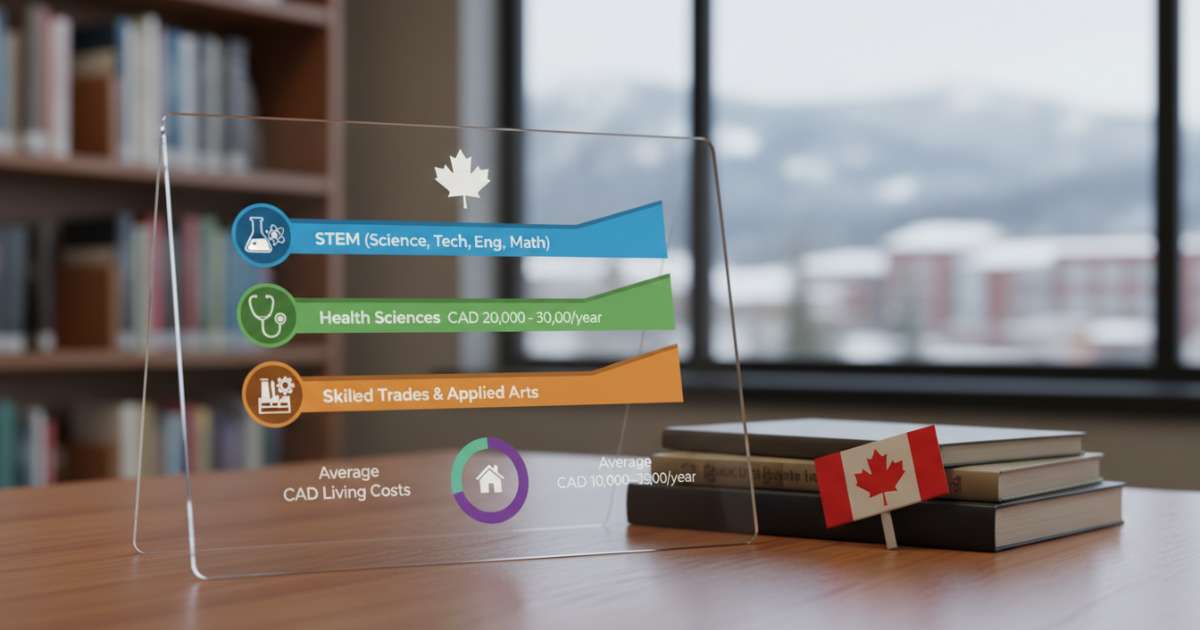
Tuition is the largest expense and varies significantly between programs. Instead of choosing general majors, the trend for 2026-2027 is to focus on fields prioritized by Canada to increase post-graduation immigration opportunities. The **study in canada cost** regarding tuition for these sectors usually represents an investment worthy of future income potential and career opportunities.
2.1. Costs for the Healthcare and Medical Care group
The Healthcare sector, including Nursing, Personal Support, and Health Management, is always at the top of Canada’s priority list. Tuition for Healthcare programs typically ranges from 18,000 CAD to 25,000 CAD per year at public colleges. For medical doctor or specialist programs at universities, the fee can reach 40,000 CAD or higher.
However, this is the industry with the clearest immigration pathway through category-based Express Entry invitations.
2.2. Fees for the STEM group
STEM (Science, Technology, Engineering, and Mathematics) is the engine of Canada’s economic growth. Tuition for software engineering, cybersecurity, or mechanical engineering usually ranges from 20,000 CAD to 35,000 CAD per year. Provinces like Ontario and British Columbia are major tech hubs where STEM students have opportunities for paid internships (Co-op) to offset part of their education costs.
2.3. Training costs for Construction and Skilled Trades
Canada is facing a housing crisis, leading to a massive demand for labor in Construction, Electrical, Welding, and Construction Project Management. When calculating the total investment for this group, you will find quite reasonable fees, starting from only 15,000 CAD to 20,000 CAD per year at vocational schools or technical colleges. Short training times and high employability upon graduation make this an economical choice for many students.
3. Living and insurance expenses per year in Canada
Besides tuition, living expenses are a crucial factor affecting the total budget. The annual **study in canada cost** depends heavily on your lifestyle and location. Major cities like Toronto or Vancouver will have higher costs compared to rural areas or Atlantic provinces like New Brunswick or Nova Scotia.
3.1. Rent and food costs
Rent typically accounts for about 40% of living costs. If staying in a dormitory or a downtown apartment, you might spend between 1,000 CAD and 1,500 CAD per month. However, room-sharing or homestays can reduce this to 600 – 800 CAD.
Food and grocery costs usually consume about 300 – 500 CAD per month if you cook for yourself. In total, the accommodation and food portion of the budget will fall around 12,000 CAD to 18,000 CAD per year.
3.2. Other mandatory fees
International students are required to purchase health insurance, which usually ranges from 600 CAD to 1,000 CAD per year depending on the province. Additionally, public transportation costs, study materials, and extracurricular activities should be budgeted at approximately 2,000 CAD per year. Understanding these smaller items will help you manage your finances better and avoid unexpected expenses.
4. Document conditions and new financial requirements for Study Permits
To obtain a Study Permit in the 2026-2027 period, your application must meet stricter standards from the IRCC. Proving your financial capability must be demonstrated through transparent and highly persuasive documents. In addition to financial capacity, the study plan must be logical and directly related to your experience or career orientation in priority sectors.
4.1. Regulations on Provincial Attestation Letters (PAL)
Currently, most international students applying for a Study Permit at the college and university levels require a Provincial Attestation Letter (PAL). This is a mechanism for the government to control student numbers in each region. Choosing provinces that are hungry for healthcare and construction workers can make obtaining a PAL and a visa more favorable.
This also affects the overall budget as each province has different administrative fees and support policies.
4.2. Proving sustainable financial capacity
It is not just about having enough money in a savings book; you need to prove the source of income for your sponsor. Consultants often advise families to prepare a financial source that exceeds the minimum required by the IRCC. When planning your budget, you should be prepared for actual spending to be higher than the figures on paper to ensure your studies are not interrupted.
5. 24-hour weekly work regulation and financial optimization
One of the important changes is the regulation on the number of off-campus work hours for international students. Instead of being allowed to work unlimited hours as during the pandemic, students are now limited to a maximum of 24 hours per week during academic terms. This directly impacts the calculation of your net expenses as income from part-time work will be more restricted than before.
5.1. Expected income from part-time work
With an average minimum wage of about 15 – 17 CAD per hour, a student working the full 24 hours/week can earn about 1,500 CAD per month. This amount is enough to cover most monthly living expenses but is unlikely to cover tuition fees. Therefore, students need to have financial preparation beforehand and should not over-rely on “working to pay for school.”
5.2. Choosing Co-op programs to reduce cost pressure
Paid internship programs (Co-op) are an excellent solution to optimize the **study in canada cost**. During Co-op semesters, students work full-time with professional salaries much higher than general part-time jobs. Especially in STEM and Construction, Co-op income can help you pay a large portion of the following year’s tuition while accumulating valuable Canadian work experience.
6. School selection and Canada PR pathways 2027 via priority streams
Immigration is no longer an open door for everyone in a general way. From 2026 onwards, Canada’s immigration policy focuses heavily on addressing labor shortages in essential sectors. Understanding the total investment alongside a smart settlement roadmap will help you save both time and money.
6.1. Settlement priority for Healthcare and STEM groups
The Express Entry system has now implemented category-based selection draws. Graduates in Healthcare, STEM, and Construction have the opportunity to receive invitations for permanent residency with lower CRS scores compared to business or social science groups. When you invest in tuition for these fields, you are essentially buying a safer “ticket” to becoming a Canadian permanent resident.
6.2. Choosing provinces with favorable nomination policies
Many provinces like Saskatchewan, Manitoba, or the Atlantic provinces have Provincial Nominee Programs (PNP) specifically for local graduates in priority occupations. In these areas, the cost of living is often lower than in major metropolises, while immigration opportunities are higher. This is a “step back to leap forward” strategy that many smart international students are applying for their 2026-2027 plans.
6.3. The importance of early roadmap consultation
Because Canada’s immigration regulations change constantly, having a reputable consulting unit to accompany you is very important. They will help you evaluate, based on your current budget, what the appropriate **study in canada cost** is and which major will bring the highest immigration potential for you in 2027. Don’t let tuition figures discourage you, because if you choose the right field, the value you receive back will be much greater than the initial cost.
The journey of studying and settling in Canada during the 2026-2027 period requires serious preparation in terms of both finance and knowledge. Identifying the clear **study in canada cost** and focusing on priority occupations such as Healthcare, STEM, or Construction will help you optimize your chances of success. Start planning today to turn your Canadian dream into reality in the most sustainable way.
If you are concerned about your personal profile or need a detailed cost estimate for specific majors, do not hesitate to seek professional support. Assessing your settlement potential early will help you choose the right school, the right major, and maximize your investment savings.
Let SIEC accompany you in building the most optimal study and settlement roadmap in Canada for 2027. Our team of experts will help you analyze fees in detail, choose majors that fit labor market trends, and prepare the most perfect Study Permit application.
Contact SIEC now for in-depth consultation and receive a free immigration opportunity assessment tailored specifically for you. We are committed to providing transparent, updated information and personalized solutions for each client.
Assess your Canada 2027 settlement potential now by registering your information at SIEC to receive dedicated advice from experienced experts in the field of study abroad and immigration.
Are You Ready to Breakthrough Your Global Career with SIEC?
Don’t let your prestigious degree just stay on paper. Let SIEC experts advise you on a study abroad roadmap combined with a job-oriented strategy starting today!
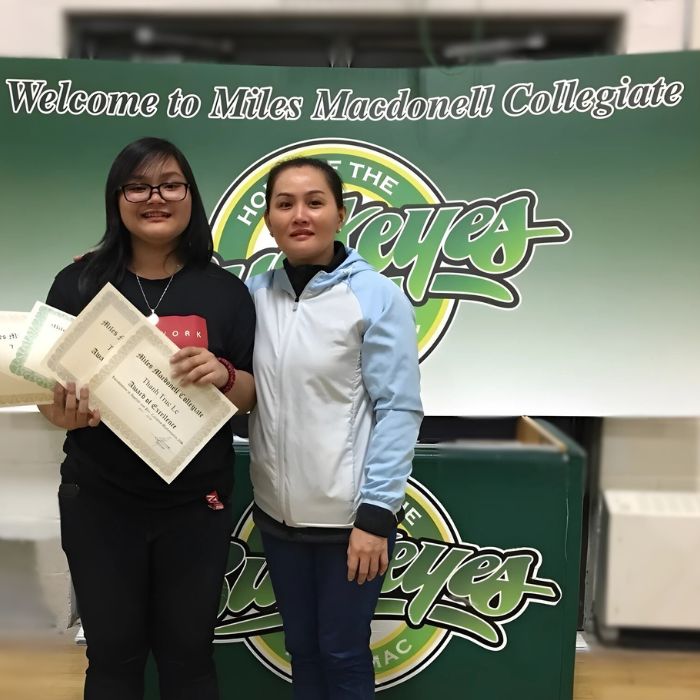
Lê Thanh Trúc, Student at Miles Macdonell Collegiate
“My family and I are deeply grateful to SIEC for not only securing my **Canada high school student visa** in Grade 10 but also for assisting my parents and siblings in obtaining their **visitor visas**. That was an invaluable gift.” — Lê Thanh Trúc, Student at **Miles Macdonell Collegiate** Secure Your Early High School (Secondary) […]
Phan Thị Ngọc Huỳnh, Former Student in Winnipeg
“The solid foundation provided by SIEC and Ms. Huong not only helped me realize my study abroad dream but also gave me the confidence to graduate, secure a stable job, and **settle permanently in Canada**.” — Phan Thị Ngọc Huỳnh, Former Student, currently working in **Winnipeg, Canada** Explore Your Study & Immigration Pathway in Canada […]
Hoàng Giang, Student at Edmonds College
“With her dedication and passion, Ms. Huong helped launch my **American dream**, opening up a vast world of opportunity and the chance to meet new friends.” — Hoàng Giang, Student at **Edmonds College** Explore More About Studying in the USA Spotlight on Edmonds College (Washington State) Gain in-depth knowledge about the programs, tuition fees, and […]
Khánh Lê, Student at LaSalle College
“Thank you to Ms. Huong and the SIEC team for their dedicated partnership and support, from my application phase until I was settled in Canada, helping me confidently pursue my dreams.” — Khánh Lê, Student at **LaSalle College** Explore Further Canada Study Opportunities Spotlight on LaSalle College Gain deeper insights into the programs, tuition fees, […]
Quỳnh Giao, Student at Red River Colleg
“She didn’t just stop at completing the application; she was an inspiration, a true motivator…” — Quỳnh Giao, Student at **Red River College** Continue Your Canada Study Abroad Journey Spotlight on Red River College Polytechnic (RRC Polytech) Discover the high-demand, **applied learning programs** at **Red River College** – one of the premier post-secondary institutions in […]