Rejected by a US University? The Truth Behind Your “Denied” Status and the Roadmap for a Spectacular Comeback
07/03/2026 Phong Nguyen
The sinking feeling of opening an email early in the morning only to see those cold words: “We regret to inform you…” is one of the most painful experiences on the journey to the American Dream. Months of late-night SAT prep and dozens of essay drafts seem to vanish in an instant. You inevitably fall into a spiral of self-doubt: “Why? My GPA is at the top of my class. My extracurriculars are extensive. Why was I rejected by US universities?”
You are not alone. In the 2025-2026 admissions cycle, acceptance rates at Ivy League and Top 50 universities hit record lows due to a global surge in applications. Thousands of exceptional students are receiving the exact same letter. At SIEC, we want to make one thing clear: Being rejected by a US university is not a judgment of your worth or potential. It is often the result of a temporary lack of “institutional fit” or a flaw in your application strategy—both of which can be fixed.
This article isn’t about empty platitudes. We are going to dissect the hard truths that admissions committees rarely disclose and provide a comprehensive, 2,000-word “Comeback Roadmap.” Learn exactly why you were rejected by US universities and how to turn today’s setback into a spectacular victory in the next cycle.
Don’t let a rejection define your future. When one door closes, a more strategic path often opens.
Truth #1: Why Do “Perfect” Profiles Get Rejected by US Universities?
The US education system is famous for its “Holistic Review” process, especially via The Common Application. This means a perfect score is never a 100% guarantee of admission. An application that seems “weak” to an admissions officer is often one that has high scores but lacks a unique identity, leading to a heartbreaking US study abroad rejection.
Reason 1: You are a “Flat” Applicant
This is the most common mistake among high-achieving students. You have a 4.0 GPA, a 1550 SAT, 10 charity clubs, piano skills, and you’re the captain of the soccer team. Sound perfect? To top-tier universities, this is the portrait of a “flat” applicant—someone who is good at everything but master of nothing. This is a primary reason students are rejected by US universities.
Admissions committees don’t want a class of well-rounded individuals; they want a “Diverse Class” of well-rounded peers. To build this, they seek individuals with a “Spike”—an extraordinary depth in one specific area. If you try to please everyone by being a generalist, you leave no lasting impression.
Reason 2: The “Safe” Essay – The Enemy of Engagement
Among tens of thousands of 2026 applications, your essay is the only place you have a direct conversation with the reader. A fatal error leading to US university rejection is writing about cliché topics or using AI to generate text, which strips away authentic emotion. Committees seek vulnerability, self-awareness, and critical thinking—not a polished but soulless template.
Reason 3: The Return of SAT/ACT Requirements in 2026
The year 2026 marks a turning point as elite institutions (like Harvard, Yale, MIT, and Caltech) have fully reinstated standardized testing requirements. If you maintain a “Test-Optional” mindset without a competitive SAT/ACT score, your profile becomes inherently disadvantaged. Failing to adapt to these new recruitment trends is a fast track to being rejected by US universities.
The Comeback Roadmap: A 5-Stage Plan for Success
Do not let the disappointment of being rejected by a US university last more than a week. Start improving your US study application immediately with a scientific and persistent strategy.
Stage 1: The Post-Mortem (Diagnostic Analysis)
To avoid repeating the same mistakes, you need an objective perspective. Let SIEC experts audit your profile: Was your school list too “reach-heavy” for your stats? Did your supplemental essays fail to demonstrate deep research into the school? Identifying the specific gap is 50% of the battle in overcoming a US university rejection.
Stage 2: Optimizing the Gap Year – Turning One Year into Gold
A “Gap Year” is often the best answer to “what to do after being rejected by US universities?”. However, an aimless gap year will weaken your profile. In 2026, universities are looking for IMPACT.
Instead of joining five more clubs superficially, focus on one high-level project. If you love science, find a research internship. If you love business, launch a small startup. Your resilience after being rejected by a US university is best proven through tangible real-world growth.
Application Element
Common Rejection Trigger
The “Comeback” Solution
SAT/ACT Scores
No score submitted or below 1450 for Top 30.
Aggressive prep to achieve 1500+ for safety.
Personal Statement
Focusing on achievements rather than personal growth.
Writing about resilience after being rejected by US universities.
Extracurriculars
High volume but lack of leadership or impact.
Pivot to one community-impacting project with measurable results.
Stage 3: Restructuring the Narrative – Telling a New Story
Your re-application essay should not be a copy of the old one. Confront the fact that you were previously rejected by US universities head-on. Explain how that failure changed your worldview, what you learned about resilience, and what you did to become a better version of yourself. “Underdog” stories are incredibly compelling to US admissions officers.
Stage 4: Strategic School List Optimization
Perhaps your previous list was too ambitious. For 2026, apply the 2-4-2 rule: 2 Reach schools, 4 Match schools, and 2 Safety schools. Don’t overlook Liberal Arts Colleges (LACs)—they often have generous financial aid and provide personalized attention that significantly lowers the risk of being rejected by a US university.
Stage 5: Leveraging the Transfer Pathway
If you don’t want to wait for a Gap Year, consider Community Colleges. This is not a step back; it is a strategic bridge. In 2026, the success rate for students transferring from community colleges to elite universities like UC Berkeley or UCLA is impressively high.
Why is this pathway so effective?
Academic Reset: Your college GPA in the US replaces your high school grades, eliminating past academic issues that caused you to be rejected by US universities.
Cost Efficiency: Tuition is often 1/3 the cost of a 4-year university.
High Acceptance Rates: Many Top Tier schools have dedicated quotas and priority for transfer students.
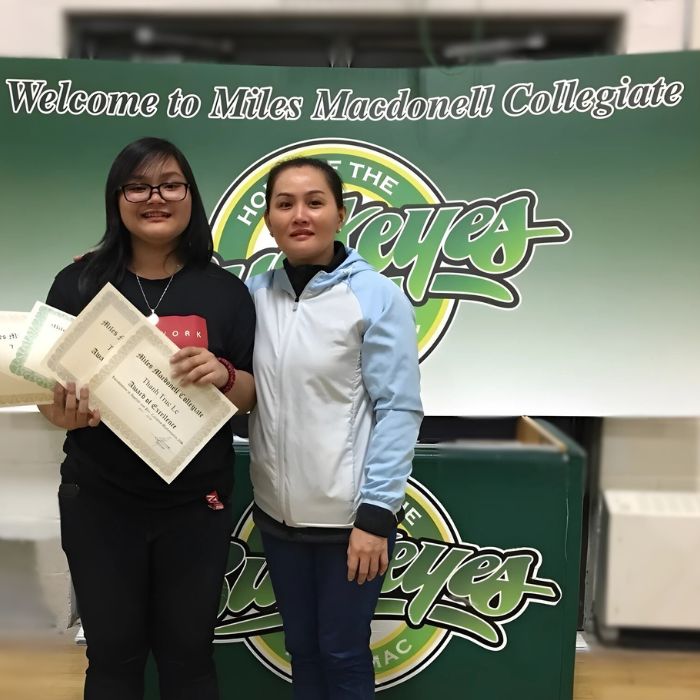
Lê Thanh Trúc, Student at Miles Macdonell Collegiate
“My family and I are deeply grateful to SIEC for not only securing my **Canada high school student visa** in Grade 10 but also for assisting my parents and siblings in obtaining their **visitor visas**. That was an invaluable gift.” — Lê Thanh Trúc, Student at **Miles Macdonell Collegiate** Secure Your Early High School (Secondary) […]
Phan Thị Ngọc Huỳnh, Former Student in Winnipeg
“The solid foundation provided by SIEC and Ms. Huong not only helped me realize my study abroad dream but also gave me the confidence to graduate, secure a stable job, and **settle permanently in Canada**.” — Phan Thị Ngọc Huỳnh, Former Student, currently working in **Winnipeg, Canada** Explore Your Study & Immigration Pathway in Canada […]
Hoàng Giang, Student at Edmonds College
“With her dedication and passion, Ms. Huong helped launch my **American dream**, opening up a vast world of opportunity and the chance to meet new friends.” — Hoàng Giang, Student at **Edmonds College** Explore More About Studying in the USA Spotlight on Edmonds College (Washington State) Gain in-depth knowledge about the programs, tuition fees, and […]
Khánh Lê, Student at LaSalle College
“Thank you to Ms. Huong and the SIEC team for their dedicated partnership and support, from my application phase until I was settled in Canada, helping me confidently pursue my dreams.” — Khánh Lê, Student at **LaSalle College** Explore Further Canada Study Opportunities Spotlight on LaSalle College Gain deeper insights into the programs, tuition fees, […]
Quỳnh Giao, Student at Red River Colleg
“She didn’t just stop at completing the application; she was an inspiration, a true motivator…” — Quỳnh Giao, Student at **Red River College** Continue Your Canada Study Abroad Journey Spotlight on Red River College Polytechnic (RRC Polytech) Discover the high-demand, **applied learning programs** at **Red River College** – one of the premier post-secondary institutions in […]