Winning the US Student Visa Interview 2026: 15 Common Questions & Expert Answer Strategy
18/11/2025 Phong Nguyen
After successfully navigating the challenges to receive your I-20 Form (Certificate of Eligibility), the U.S. Student Visa Interview (F-1) 2026 is the final, and most critical, hurdle. In just a few brief minutes, you must convince the Consular Officer that you are a genuine student deserving of the F-1 visa. Anxiety, pressure, and the fear of a “visa refusal” are common emotions for every Vietnamese student preparing for this crucial interview.
However, success is not a matter of luck. It comes from thorough preparation, unwavering confidence, and an intelligent answering strategy. With extensive experience in helping thousands of applicants succeed, this in-depth guide from SIEC will “decode” the entire process, analyze the 15 core F-1 visa interview questions, and provide proven answering tactics to help you turn your U.S. student visa interview 2026 into a shining success.
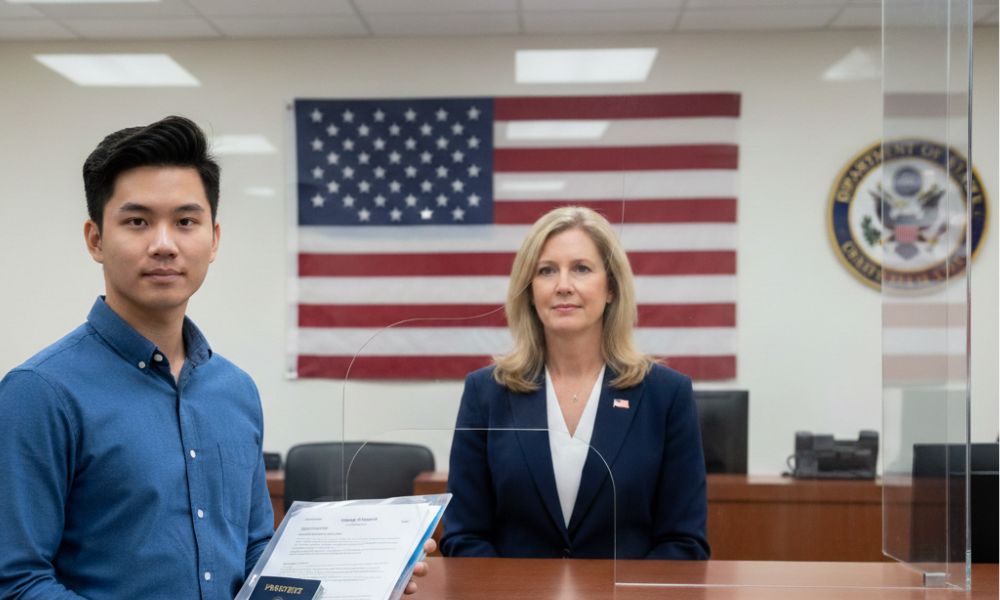
ALT Tag Optimized: Vietnamese student confidently undergoing a U.S. student visa interview 2026 with the Consular Officer. Confidence and meticulous preparation are the keys to F-1 visa success.
1. Understanding the Consular Officer’s Goal: The Three Pillars of F-1 Visa Success (Strategy and Psychology)
Before diving into the questions, you must understand the interviewer’s objective. They are not trying to trip you up. Instead, they are looking for answers to three major questions. Every query during your U.S. student visa interview 2026 aims to address these core concerns:
Are you a Genuine Student? (Is your academic purpose clear, serious, and logical?)
Do you have Sufficient Financial Capacity? (Can your family afford the entire course without illegal employment?)
Do you have a clear Intent to Return to Vietnam after graduation? (Are your ties to your home country strong and convincing?)
All questions in the U.S. student visa interview 2026 revolve around these three pillars. If you fail to convince them on any one point, your application may be denied under Section 214(b) of the Immigration and Nationality Act, which stipulates that “every applicant for a non-immigrant visa shall be presumed to be an immigrant until he/she establishes to the contrary.” The entire secret to a successful F-1 visa interview 2026 lies in demonstrating these three factors.
1.1 In-Depth Analysis of Section 214(b) – The Biggest Hurdle for F-1 Visa Applicants (Fact-Check)
Section 214(b) is the most common legal basis for non-immigrant visa denials. Essentially, it places the burden of proof entirely on you. The Consular Officer presumes you will attempt to stay in the U.S. unless you prove otherwise. Therefore, the U.S. student visa interview 2026 is not where you list achievements, but where you build a logical academic and career narrative that is inseparable from your future in Vietnam. Inconsistency between your qualifications and your future plans is the top reason for F-1 visa refusal.
Strategy to Overcome 214(b): Focus on emphasizing the uniqueness of the U.S. academic program relative to your career path in Vietnam. For example, if you study Renewable Energy, point out that Vietnam’s technology and development policies in this sector urgently require U.S.-trained personnel. Or, if you study Chip Design, link it to the significant investments the Vietnamese Government is making in the semiconductor industry. This is the successful approach during the U.S. student visa interview 2026, making your profile unique and highly valuable.
2. 15 Common U.S. Student Visa Interview Questions 2026 and Detailed Answering Strategy (Core Content)
Below are the core question groups and intelligent, in-depth answering strategies for a successful U.S. student visa interview 2026. Thorough preparation for these questions is critical for a positive outcome.
Group 1: Questions about Academic Plan (Proving You are a Genuine Student in Your F-1 Visa Interview)
This is the most crucial group for demonstrating that you are a serious student, not using studying abroad as a pretext. Always remember the goal of the U.S. student visa interview 2026 is to convince the Consulate of the direct link between your studies and your future career back in Vietnam.
Question 1: Why did you choose to study in the U.S. and not another country? Underlying Purpose: To test the depth of your research and commitment. Strategy: Focus on the specific strengths of U.S. education that other countries lack (or are less strong in) within your field. Example: “Sir/Madam, I chose the U.S. because the Computer Science program here is highly flexible, allowing me to select specialized courses in Artificial Intelligence, điều mà các chương trình ở Anh hay Úc em tìm hiểu không có được. Hơn nữa, cơ hội tham gia các dự án nghiên cứu cùng giáo sư ngay từ bậc đại học là một điểm mạnh vượt trội của giáo dục Mỹ.” Elaboration: Mention the diversity of elective courses, vast research libraries, or advanced technologies only available in the U.S. to demonstrate your deep research in the U.S. student visa interview 2026.
Question 2: Why did you choose [Name of University]? Underlying Purpose: To evaluate if your school choice is deliberate or random. Strategy: Be specific. “I chose the University of California, Irvine because the school has a very famous Institute for Computer Game Research, and I have read Professor Smith’s research on this field. Em tin rằng đây là môi trường tốt nhất để em theo đuổi đam mê phát triển game.” Elaboration: Link the school to the city or region. Try to mention the names of 2-3 specific professors or courses you plan to take. This makes your answer in the U.S. student visa interview 2026 more credible.
Question 3: Why did you choose this field of study? Underlying Purpose: To find logic and passion in your academic plan. Strategy: Tell a brief story about your passion, linking it to your existing experience and a clear career objective in Vietnam. “Từ nhỏ em đã thích lập trình, and I self-taught Python to write a few small applications. I want to systematically develop these skills in the U.S. so I can return and work for major technology companies in Vietnam, such as VNG or FPT Software.” Elaboration: Ensure your current field of study is logically connected to previous qualifications. If switching fields, you must explain that the change is a logical step towards your ultimate career goal, which is a crucial point in the U.S. student visa interview 2026.
Question 4: What are your plans after graduation? Underlying Purpose: To test your intent to return and the clarity of your career plan. Strategy: Present a 2-3 step plan. “After graduation, I plan to work for 1-2 years in the U.S. under the OPT program to gain practical experience in a professional environment. Sau đó, em sẽ trở về Việt Nam to apply for a Senior Software Engineer position at the rapidly growing technology companies in my home country.” Elaboration: Name one or two specific companies in Vietnam you are targeting. Clearly demonstrate that the purpose of studying abroad is to serve your career in Vietnam during the U.S. student visa interview 2026.
2.1 Optimizing Your Academic Plan (Group 1): Weaknesses and How to Fix Them in Your F-1 Interview (In-Depth Content)
Many applicants make the mistake of giving overly general answers during the U.S. student visa interview 2026. Instead of saying “U.S. programs are good,” say, “The Master’s program in Digital Marketing at NYU focuses heavily on data analytics and AI, which is completely different from the theoretical programs available in Vietnam.” Personalize your answer.
For High School Students: Link your personal passions to extracurricular activities or awards you have won. The goal is to show that studying is not a burden but the pursuit of a clear goal, helping you feel more confident in the U.S. student visa interview 2026. Clearly state that you have researched Pathway programs or Community Colleges if that is your academic route.
For Transfer or Graduate Students: Always maintain continuity in your story. Show that the new qualification is a necessary step forward, not a random deviation. If switching fields, clearly explain why your current qualification is insufficient and why the new U.S. qualification is the final missing piece you need to achieve your career goals in Vietnam.
Group 2: Questions about Financial Capacity (Proving You are Not a Burden in Your F-1 Visa Interview)
Your answers must be confident, clear, and perfectly consistent with your documents. Any hesitation during the U.S. student visa interview 2026 can be interpreted as dishonesty, especially with increasing scrutiny of student finances.
Question 5: Who will pay for your studies? Strategy: Answer directly: “My parents will pay for all the expenses.” If you have a scholarship, proudly state: “My studies are covered 50% by a scholarship from the university (remember the exact figure), and the rest is supported by my family.” Elaboration: If your financial sponsor is not your immediate parent, you must be prepared to explain the relationship and why they are sponsoring you in the U.S. student visa interview 2026 (Example: Uncle sponsoring because they are the heir to the family business).
Question 6: What is your father/mother’s job? What is their monthly/annual income? Strategy: Know and state the exact figures declared in your application. Answer clearly, for example: “My father is the director of Company X, specializing in agricultural exports, with an income of approximately…/year. My mother is a credit manager at Bank Y with an income…/year.” Elaboration: The annual income must be sufficient to cover tuition and living expenses while also supporting the family in Vietnam. Meticulous financial preparation is a decisive factor in the U.S. student visa interview 2026.
Question 7: Bạn có giấy tờ chứng minh tài chính ở đây không? Strategy: Always answer “Yes, I do” and be ready to present the documents, which should be organized logically. Don’t wait for them to ask; if they seem concerned about finances, you can proactively say: “Em có mang theo đầy đủ giấy tờ chứng minh thu nhập và sổ tiết kiệm nếu ông/bà muốn xem ạ.” This preparation helps you be more confident during the U.S. student visa interview 2026.
2.2 Core Financial Documentation Checklist (Fact-Check) for F-1 Visa Interview 2026 (Elaboration)
To overcome the financial hurdle in the U.S. student visa interview 2026, your documents must ensure: (1) The ability to pay for the first year’s expenses and (2) A legal, stable source of funds for the following years. Financial Fact-check: The Consular Officer is more concerned with the **source** of the money than the total amount in the account.
Category A: Proof of Available Cash: Savings book or Bank Statement (must cover at least 1 year of tuition + living expenses as per the I-20). The date the savings account was opened is also important (it should ideally be opened at least a few months prior).
Category B: Proof of Sponsor’s Income Source: Pay stubs, employment contracts, business licenses, or personal/corporate income tax records for the last 2-3 years. The transparency and stability of the income source are paramount. If the sponsor is a business owner, be sure you know the type of business and the actual revenue/profit.
Category C: Supporting Assets: Real estate ownership documents (red book/title deed), vehicle registrations, stock certificates (these are supplementary factors only, they do not replace income and savings).
Group 3: Questions about Intent to Return (Proving Ties After F-1 Visa Interview)
This is the section where you must demonstrate strong and convincing ties to Vietnam, affirming that you have no intention of immigrating. Thorough preparation for this part will ensure the success of your U.S. student visa interview 2026.
Question 8: Do you have any relatives in the U.S.? Strategy: Always answer truthfully. If you have, clearly state the relationship and their status. Honesty is valued over concealment in the U.S. student visa interview 2026. Elaboration: If the relative has immigrant status, you must clearly explain that their presence does not affect your academic purpose and your goal of returning home. The focus is: You are returning to Vietnam for a career goal, not despite their presence.
Question 9: Why do you think you will return to Vietnam after graduation? Strategy: Provide specific and compelling reasons. “My entire family is in Vietnam, and I am the only child, so I have the responsibility to care for my parents. Furthermore, my family’s company needs someone with expertise in international business administration to inherit and develop it. This is my biggest career opportunity.” Elaboration: Ties can be: (1) Family, (2) Economic (inheriting a family business/career), (3) Social/Professional (the necessity of your specialization in the Vietnamese market). Be sure to emphasize these factors in the U.S. student visa interview 2026.
Question 10: Do you plan to stay and work in the U.S.? Strategy: Answer delicately. “I do plan to utilize the OPT program to gain practical experience, but my long-term and certain goal is to return and apply that knowledge to advance my career in Vietnam.” Elaboration: Nhấn mạnh OPT chỉ là một công cụ học tập mở rộng chứ không phải là con đường định cư. The ultimate purpose of using OPT is to serve your career back home, as that specific technology/knowledge is needed in Vietnam.
2.3 Demonstrated Ties You Need to Prove (Fact-Check) for F-1 Visa Interview 2026 (Elaboration)
The Consular Officer looks for evidence of strong “economic, social, and family ties” in your home country. A good answer is not just saying “I will return” but “I must return because…”
Family Ties: Not just parents, but family commitments or personal responsibilities (ví dụ: là người chăm sóc chính, hoặc người duy nhất thừa kế dòng họ).
Economic/Career Ties: This is the strongest tie. If you have evidence that your parents have signed over a portion of the company after your graduation, or if a major Vietnamese company has sent a conditional job offer letter, use it to reinforce your answer.
Asset Ties: If you own real estate or other assets in Vietnam (dù còn ít tuổi), that is tangible proof that you have property to return and manage.
Group 4: Situational and Personal Questions (Testing Honesty and Reflexes in Your F-1 Visa Interview)
Question 11: Why are your grades in [Subject Name] low? Strategy: Admit honestly and show that you learned a lesson. “Dạ, năm lớp 10 em đã hơi lơ là môn Vật lý. But I realized its importance afterward and worked hard to improve; my scores in 11th and 12th grade were much better.” Elaboration: Avoid blaming or making excuses. Focus on corrective action and personal growth.
Question 12: Have you ever been refused a U.S./other country visa? Strategy: Tuyệt đối không nói dối. If you have, briefly explain the reason and show how you have rectified that weakness in this application. This is very important when attending the U.S. student visa interview 2026. Elaboration: If refused under 214(b) last time, say: “Lần trước, em nghĩ mình chưa thể hiện rõ ràng về kế hoạch sự nghiệp tại Việt Nam. This time, I have prepared a more detailed plan, proving that this qualification is a mandatory step for me to grow the family business.”
Question 13: What do you know about U.S. immigration laws? (New/Supplementary Open Question) Strategy: Show a basic understanding of the F-1 visa (non-immigrant visa, not allowed to work full-time, must maintain student status). This shows you are a serious applicant.
Question 14: Why should we grant you a visa? Strategy: Tóm tắt lại 3 điểm mạnh nhất của bạn: serious study plan, solid finances, and a clear plan to return. This is the closing question for the U.S. student visa interview 2026. Summary of the 3 Pillars: “Em tin rằng việc cấp visa cho em là hợp lý vì (1) Em có kế hoạch học tập chi tiết, rõ ràng tại trường [Tên trường]; (2) Hồ sơ tài chính của gia đình em minh bạch và ổn định; (3) Em có mối ràng buộc mạnh mẽ và một mục tiêu sự nghiệp lớn tại Việt Nam sau khi tốt nghiệp.”
**Overall Strategy:** Always be truthful, answer concisely, maintain a positive attitude, and show maturity. A successful U.S. student visa interview 2026 demands sincerity.
3. Comprehensive Preparation for Your U.S. Student Visa Interview Day 2026: Checklist & Psychological Optimization
Success comes from 90% preparation and 10% execution. Preparation for the U.S. student visa interview 2026 extends beyond content to include appearance and mindset.
3.1 Document Optimization (The Documents Binder) for Your F-1 Visa Interview 2026
Documents must be organized logically and easily accessible. Use a 3-ring binder and divide it into clear sections. When the officer asks during the U.S. student visa interview 2026, you must be able to retrieve it instantly.
Academic/I-20 Section: Passport, I-20 (original with signature), SEVIS fee receipt, DS-160 confirmation page, academic degrees, transcripts, scholarship letter (if applicable).
Financial Section: Savings book/Bank Statement, Detailed income proof (tax, business), Affidavit of Support.
Ties Section: Asset ownership documents (if applicable), Birth Certificate, Household Registration (to prove family ties), Conditional job offer letter upon return (if applicable).
3.2 Attire and Body Language During Your F-1 Visa Interview 2026 (Psychological Optimization)
Attire must reflect seriousness and respect. Body language is the non-verbal element, often determining 60% of the initial impression during the U.S. student visa interview 2026.
Attire: Formal but comfortable. Choose a light-colored shirt, dress pants, or a skirt/suit (for women). Avoid overly casual or overly lavish attire (like party wear).
Eye Contact: Maintain direct eye contact (through the glass window). This shows honesty and confidence, which is critical for the U.S. student visa interview 2026.
Posture: Sit up straight, hands resting on your lap or the counter (if available). Avoid crossing your arms, fidgeting, or constantly tapping your fingers. A light smile when beginning and ending the conversation always creates a good impression.
4. “Fatal” Mistakes to Absolutely Avoid During the U.S. Student Visa Interview 2026
Many applicants are refused not because of a weak profile but because they made fundamental errors during the U.S. student visa interview 2026.
Answering by Memorization: This leads the Consular Officer to doubt whether you truly understand what you are saying. Turn your answer into a natural conversation, with flexible adjustments.
Long-winded, Off-topic Answers: Consular Officers have very little time (usually just 3-5 minutes). Get straight to the point in 2-3 sentences, and only elaborate if they ask further.
Contradictory Information: Your answer must match 100% of what you declared in the DS-160 application and other documents. Ví dụ: If you say your father is a director, the financial documents must prove it.
Lack of Confidence, Poor Eye Contact: Look directly at the Consular Officer (through the glass), smile, and show composure.
Lack of Cultural Sensitivity: Avoid using slang or overly familiar language. Always maintain a respectful and professional demeanor.
5. SIEC’s Role in F-1 Visa Interview Preparation 2026: The Key to Strategic Optimization
Understanding the questions is one thing, but practicing and building confidence is another. That is why the U.S. student visa interview 2026 training sessions at SIEC play a decisive role. We help you navigate this stressful phase with the best possible preparation for success in your F-1 visa interview.
✅ Mock Interviews with Experts: You will experience a simulated interview based on your actual profile, helping you get accustomed to the pressure and practice your reflexes. Our experts have deep experience in asking “trap” questions to test the consistency of your profile for the U.S. student visa interview 2026.
✅ Building a Logical Story “Script”: SIEC experts will help you connect the strengths in your profile, forming a persuasive, logical, and consistent academic and career narrative, focusing maximally on your goal of returning to Vietnam. This script is optimized for the U.S. student visa interview 2026 and based on Vietnam’s socio-economic landscape in 2026.
✅ Financial Profile Optimization: We support you in preparing the most transparent and logical set of financial documents, highlighting the stable income source and the long-term payment capacity of your sponsor.
5.1 The Importance of Practicing Quick Reflexes for the F-1 Visa Interview 2026
Consular Officers often change the order and manner of questioning. If you only memorize answers, you will easily become flustered. Training at SIEC focuses on creating natural reflexes, allowing you to flexibly adjust your answers while firmly maintaining the three core pillars of your profile. This is the key factor for success in the U.S. student visa interview 2026.
The simulated practice process will give you a deep understanding of every aspect of your own profile. This absolute confidence is the strongest element to convince the Consular Officer in the U.S. student visa interview 2026.
VI. Final Word: Conquering the F-1 Visa with Maximum Preparation for the U.S. Student Visa Interview 2026
The U.S. student visa interview 2026 is a test of preparation and confidence. By clearly understanding the Consulate’s objective, mastering the strategy, and practicing diligently, you can absolutely conquer your American dream. Remember, the success of your F-1 visa interview depends on you.
Don’t gamble your future on luck. Let SIEC’s real-world experience turn your U.S. student visa interview 2026 into a winning opportunity.
Are you ready for your U.S. student visa interview 2026? Register for a free consultation today to schedule a complimentary 1-on-1 F-1 visa interview preparation session!
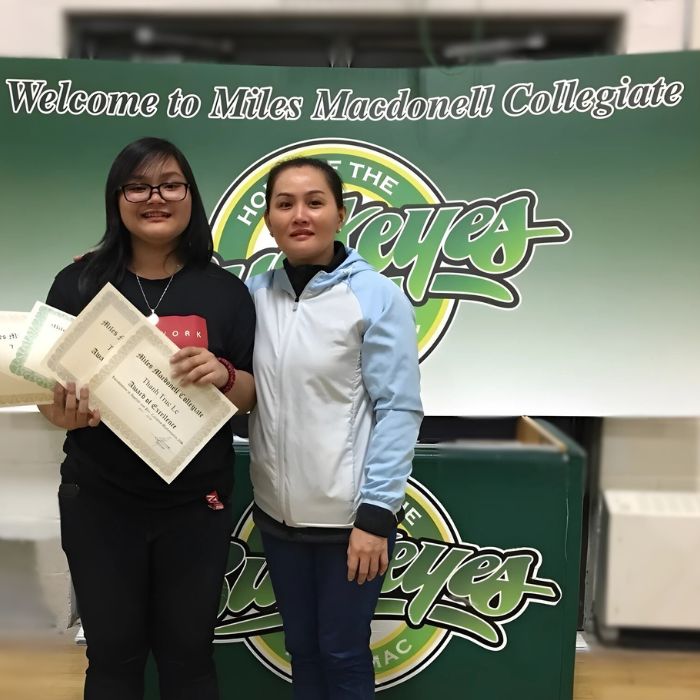
Lê Thanh Trúc, Student at Miles Macdonell Collegiate
“My family and I are deeply grateful to SIEC for not only securing my **Canada high school student visa** in Grade 10 but also for assisting my parents and siblings in obtaining their **visitor visas**. That was an invaluable gift.” — Lê Thanh Trúc, Student at **Miles Macdonell Collegiate** Secure Your Early High School (Secondary) […]
Phan Thị Ngọc Huỳnh, Former Student in Winnipeg
“The solid foundation provided by SIEC and Ms. Huong not only helped me realize my study abroad dream but also gave me the confidence to graduate, secure a stable job, and **settle permanently in Canada**.” — Phan Thị Ngọc Huỳnh, Former Student, currently working in **Winnipeg, Canada** Explore Your Study & Immigration Pathway in Canada […]
Hoàng Giang, Student at Edmonds College
“With her dedication and passion, Ms. Huong helped launch my **American dream**, opening up a vast world of opportunity and the chance to meet new friends.” — Hoàng Giang, Student at **Edmonds College** Explore More About Studying in the USA Spotlight on Edmonds College (Washington State) Gain in-depth knowledge about the programs, tuition fees, and […]
Khánh Lê, Student at LaSalle College
“Thank you to Ms. Huong and the SIEC team for their dedicated partnership and support, from my application phase until I was settled in Canada, helping me confidently pursue my dreams.” — Khánh Lê, Student at **LaSalle College** Explore Further Canada Study Opportunities Spotlight on LaSalle College Gain deeper insights into the programs, tuition fees, […]
Quỳnh Giao, Student at Red River Colleg
“She didn’t just stop at completing the application; she was an inspiration, a true motivator…” — Quỳnh Giao, Student at **Red River College** Continue Your Canada Study Abroad Journey Spotlight on Red River College Polytechnic (RRC Polytech) Discover the high-demand, **applied learning programs** at **Red River College** – one of the premier post-secondary institutions in […]