Post-Study Work Rights (PGWP & OPT): Your Roadmap to Residency and Financial Recovery in Canada & the USA
15/01/2026 Phong Nguyen
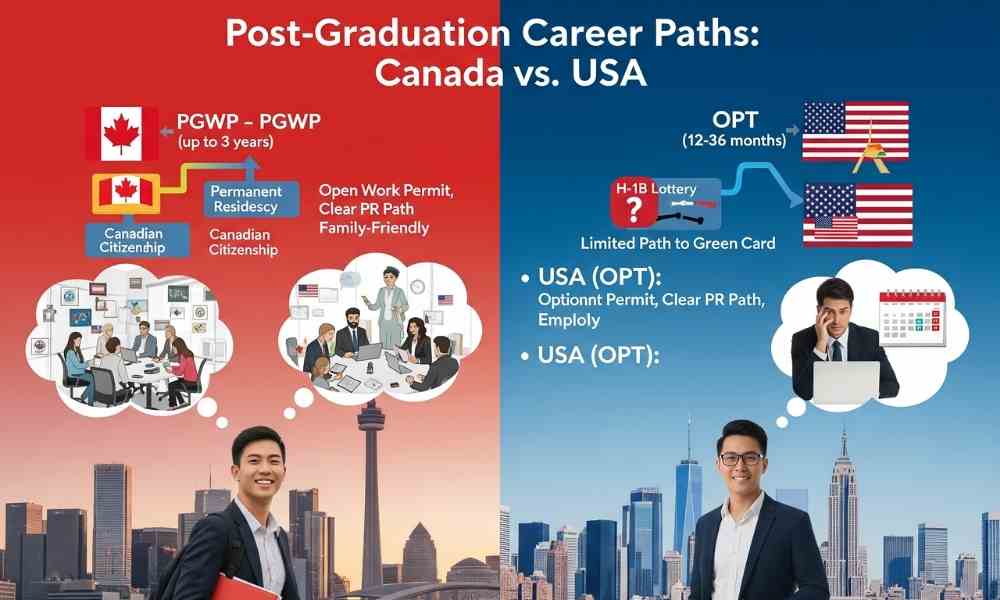
Navigating the complexities of the Canada PGWP policy and US OPT program 2026 is the most critical undertaking for international students today. Once the initial hurdle of study abroad financial proof is cleared, the focus must immediately shift to the “Exit Strategy”—how to transition from a student visa to a professional work permit. In 2026, North American immigration is no longer a “one-size-fits-all” journey; it is a high-stakes calculation involving labor market trends, language benchmarks, and legislative reforms.
The Definitive Guide to Canada PGWP Policy and US OPT Program 2026
Charting your professional future through the Canada PGWP policy and US OPT program 2026.
1. The 2026 Transformation: Why Post-Study Work Rights Matter
The global education landscape in 2026 is defined by “Value-Based Migration.” Governments in Ottawa and Washington D.C. have refined their policies to ensure that international graduates contribute directly to national economic priorities. For students, this means that simply having a degree is no longer enough; you must align your education with the specific work authorizations available. This article provides a deep-dive comparison into the Canada PGWP policy and US OPT program 2026, examining which system offers the most sustainable Return on Investment (ROI) for your career.
2. Deep Dive: The Canada PGWP Policy in 2026
The Canada PGWP policy and US OPT program 2026 comparison must begin with the massive shift in Canada’s “Open” permit philosophy. Historically, almost any program longer than eight months qualified for a work permit. However, the Immigration, Refugees and Citizenship Canada (IRCC) has now implemented a “Labor Market Alignment” strategy.
Priority Sectors for College Graduates
If you are pursuing a diploma or certificate at a college, your eligibility for a work permit is now tied to five critical sectors. These sectors were chosen based on long-term vacancy data provided by Statistics Canada:
Healthcare: Nursing, medical technology, and elder care support.
STEM: Software development, data science, and civil engineering.
Skilled Trades: Carpentry, electrical engineering, and precision welding.
Agriculture & Agri-food: Sustainable farming and food supply chain management.
Transportation: Logistics and commercial infrastructure.
The Language Threshold (CLB)
Another defining feature of the Canada PGWP policy and US OPT program 2026 is the introduction of mandatory language testing at the point of application. To secure a 3-year PGWP, university graduates must now demonstrate a Canadian Language Benchmark (CLB) of 7, while college graduates require a CLB 5. This ensures that graduates are immediately “job-ready” for the Canadian professional environment.
3. Deep Dive: The US OPT Program for 2026
While Canada focuses on sector-based immigration, the United States continues to rely on the Optional Practical Training (OPT) system to retain global talent. The Canada PGWP policy and US OPT program 2026 differ most significantly in their relationship with the employer.
Standard vs. STEM OPT
Under the 2026 guidelines from USCIS, all F-1 students are eligible for 12 months of standard OPT. However, the real advantage lies in the 24-month STEM Extension. This allows graduates in Science, Technology, Engineering, and Mathematics to work for a total of 36 months, providing three chances to enter the H-1B visa lottery—the primary path to a US Green Card.
Employment Compliance and Reporting
Unlike Canada’s “Open” permit, the US system is “Employer-Specific.” Every job you hold under OPT must be directly related to your major. In 2026, SEVIS monitoring has become automated, meaning students must report any change in employment within 10 days to maintain their legal status. Failure to do so can result in immediate termination of the F-1 visa.
4. The ROI Battle: Which Path Pays Off Faster?
For many Vietnamese families, study abroad is a family-funded project. Therefore, the Canada PGWP policy and US OPT program 2026 must be viewed through the lens of financial recovery.
The Salary Factor
The US typically offers higher gross salaries. A software engineer in Seattle or Austin might earn $115,000 USD, whereas the same role in Toronto or Vancouver might command $90,000 CAD. However, the cost of living and tax structures in 2026 have shifted. Canada offers universal healthcare and lower insurance premiums, which can save a graduate upwards of $5,000 annually compared to a US-based professional.
ROI Indicator
Canada (PGWP)
USA (OPT)
Average Starting Salary
$60k – $85k CAD
$75k – $130k USD
Time to Residency
2-4 Years (High Certainty)
6-10 Years (Low Certainty)
Healthcare Costs
Publicly Funded (Low)
Private/Employer (High)
5. Residency Pathways: From Work Permit to Citizenship
The ultimate goal of the Canada PGWP policy and US OPT program 2026 is often permanent settlement. Here, the two countries offer drastically different “Finish Lines.”
Canada: The Express Entry Advantage
Canada remains the most immigrant-friendly nation in the 2026 academic year. A graduate with one year of Canadian work experience under the PGWP can apply for Permanent Residency (PR) through the Canadian Experience Class (CEC). With the 2026 “Category-Based” draws, graduates in STEM or Healthcare are almost guaranteed an Invitation to Apply (ITA) for PR.
USA: The H-1B and EB-3 Marathon
The US path is more prestigious but riskier. After completing the US OPT program, you must secure an H-1B visa via a lottery system. If successful, your employer can then sponsor your Green Card (EB-2 or EB-3). While this leads to the highest earning potential in the world, the backlog for Green Cards means that residency can take a decade or more for many applicants.
6. Strategic Planning for Vietnamese Students in 2026
To succeed within the Canada PGWP policy and US OPT program 2026 framework, students must begin their professional development in their first semester. Networking through platforms like LinkedIn, attending university career fairs, and securing internships are no longer optional—they are mandatory for survival in a competitive 2026 job market.
Secure Your Future in North America
The Canada PGWP policy and US OPT program 2026 are constantly evolving. At SIEC, we don’t just help you get into a university; we help you build a life. Our 2026 strategy sessions cover everything from sector selection to residency audits.
✅ Personalized ROI audits for top US and Canadian universities.
✅ Expert guidance on 2026 immigration compliance and work rights.
✅ Professional networking support for international graduates.
Choosing between the Canada PGWP policy and US OPT program 2026 is a defining moment in your life. Canada offers a structured, predictable path to residency, making it the ideal choice for those seeking long-term stability and social benefits. The United States offers unparalleled financial upside and the chance to work at the forefront of global innovation, making it perfect for high-risk, high-reward individuals.
Regardless of your choice, the 2026 landscape requires a proactive mindset. By understanding the technicalities of these policies today, you ensure that your study abroad investment yields dividends for decades to come. Let SIEC be your partner in navigating this journey, ensuring that every step you take is backed by expert knowledge and strategic foresight.
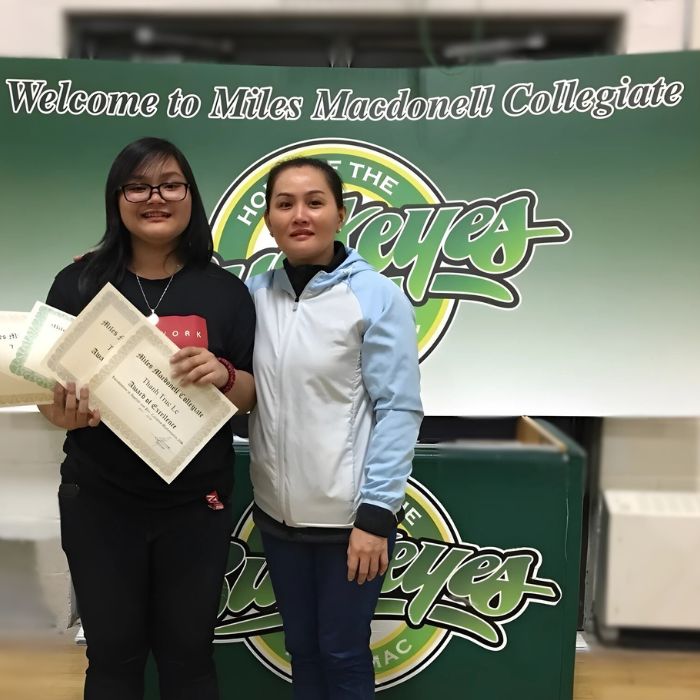
Lê Thanh Trúc, Student at Miles Macdonell Collegiate
“My family and I are deeply grateful to SIEC for not only securing my **Canada high school student visa** in Grade 10 but also for assisting my parents and siblings in obtaining their **visitor visas**. That was an invaluable gift.” — Lê Thanh Trúc, Student at **Miles Macdonell Collegiate** Secure Your Early High School (Secondary) […]
Phan Thị Ngọc Huỳnh, Former Student in Winnipeg
“The solid foundation provided by SIEC and Ms. Huong not only helped me realize my study abroad dream but also gave me the confidence to graduate, secure a stable job, and **settle permanently in Canada**.” — Phan Thị Ngọc Huỳnh, Former Student, currently working in **Winnipeg, Canada** Explore Your Study & Immigration Pathway in Canada […]
Hoàng Giang, Student at Edmonds College
“With her dedication and passion, Ms. Huong helped launch my **American dream**, opening up a vast world of opportunity and the chance to meet new friends.” — Hoàng Giang, Student at **Edmonds College** Explore More About Studying in the USA Spotlight on Edmonds College (Washington State) Gain in-depth knowledge about the programs, tuition fees, and […]
Khánh Lê, Student at LaSalle College
“Thank you to Ms. Huong and the SIEC team for their dedicated partnership and support, from my application phase until I was settled in Canada, helping me confidently pursue my dreams.” — Khánh Lê, Student at **LaSalle College** Explore Further Canada Study Opportunities Spotlight on LaSalle College Gain deeper insights into the programs, tuition fees, […]
Quỳnh Giao, Student at Red River Colleg
“She didn’t just stop at completing the application; she was an inspiration, a true motivator…” — Quỳnh Giao, Student at **Red River College** Continue Your Canada Study Abroad Journey Spotlight on Red River College Polytechnic (RRC Polytech) Discover the high-demand, **applied learning programs** at **Red River College** – one of the premier post-secondary institutions in […]