Study in Toronto: Complete Guide to Admissions and PR Path
09/05/2026 Phong Nguyen
Toronto is the largest city and the most vibrant economic, cultural, and educational hub of the Maple Leaf country. Entering the 2026–2027 period, the trend to Study in Toronto has undergone significant changes regarding immigration policies and admission requirements. Instead of the mass immigration seen in previous years, the Canadian government is now focusing on prioritizing graduates from occupational groups facing severe labor shortages.
Grasping the latest information on financial conditions, part-time work regulations, and immigration pathways according to priority sectors will help you have the most solid preparation for your future journey.
1. Application Requirements and Procedures for a Study Permit to Study in Toronto
To begin your journey to Study in Toronto, the first and most important step is preparing a complete Study Permit application. For the 2026–2027 period, Immigration, Refugees and Citizenship Canada (IRCC) has tightened the review process to ensure the quality of international students.
1.1. Letter of Acceptance and Provincial Attestation Letter
Students need a Letter of Acceptance (LOA) from a Designated Learning Institution (DLI) in Toronto. Additionally, a mandatory requirement now is the Provincial Attestation Letter (PAL) issued by the Ontario government. This is a tool to control the number of students who study in Toronto to ensure that the housing system and public services are not overloaded.
1.2. Language Proficiency and Academic Requirements
Universities and colleges in Toronto typically require an IELTS score of 6.0 to 6.5 or higher for college and undergraduate levels. For master’s programs or specialized fields such as Health and STEM, language requirements may be higher. The Grade Point Average (GPA) for the last 3 years also needs to be at a good level or higher to increase competitiveness when applying to prestigious schools to study in Toronto.
1.3. Study Plan and Criminal Record
A persuasive Study Plan is the key factor for consular officers to clearly understand your purpose for choosing to study in Toronto. You need to explain the reasons for choosing your major, the school, and your commitment to complying with Canadian regulations. In addition, students also need to provide a clean criminal record and undergo a medical exam as required to ensure eligibility for entry.
2. Updated Financial Requirements and Part-time Work Regulations for those who Study in Toronto
Financial issues are always a top concern for families when researching how to Study in Toronto. Since 2024 and continuing into the 2026–2027 period, cost-of-living requirements have increased significantly to reflect the reality of the standard of living in Toronto.
2.1. New Financial Requirements for International Students
Students applying to study in Toronto must prove they have enough financial capacity to cover tuition for the first year and living expenses. The required living expense level has now increased to over 20,000 CAD per year for an individual, instead of the 10,000 CAD level as before. This aims to ensure that students do not fall into financial hardship and can focus entirely on their studies while they Study in Toronto.
2.2. New Regulation on 24-Hour Weekly Part-time Work
Another important change is the regulation regarding off-campus work hours. Instead of being allowed to work a maximum of 20 hours as before, the Canadian government has adjusted this to 24 hours per week during study periods. This change helps students who study in Toronto have more income to cover living expenses while ensuring it does not affect their academic results.
During official scheduled breaks, students are still allowed to work full-time with no limit on hours.
2.3. The Importance of Financial Management in Toronto
Toronto is one of the most expensive cities in Canada, so clear spending planning is essential. When you Study in Toronto, you should take advantage of student discounts such as reduced public transit passes, shopping at budget supermarkets, and utilizing on-campus support services to save costs.
3. Strategies for Choosing Priority Industries for Immigration to Study in Toronto
In the 2026–2027 period, Canada’s immigration policy has seen a clear shift. Instead of opening doors to all occupations, the government is focusing on fields experiencing high-skilled labor shortages. Choosing the right major from the start when you Study in Toronto will be the key to opening the door to sustainable immigration.
3.1. Healthcare and Medical Care Sector
With an aging population, the demand for nursing, personal support workers, and medical professionals in Toronto is at record highs. Students who choose to study in Toronto in this sector often have job opportunities immediately after graduation and are prioritized in Ontario’s provincial skilled immigration draws.
3.2. STEM Sector (Science, Technology, Engineering, and Mathematics)
Toronto is known as the Silicon Valley of the North, home to thousands of tech companies large and small. Fields such as Computer Science, Data Analysis, Artificial Intelligence, and Software Engineering are always on the priority list. Students who **Study in Toronto** in the STEM block not only have high starting salaries but also easily access federal immigration programs through the Express Entry system.
3.3. Construction and Technical Trades Sector
The continuous development of infrastructure in Toronto requires a large workforce in construction, electricity, plumbing, and project management. This is a group of industries that is often overlooked but has a very open immigration pathway. Choosing vocational training courses at colleges when you study in Toronto will help you quickly join the labor market and stabilize your life.
4. List of Prestigious Schools for International Students to Study in Toronto
The education system in Toronto is very diverse with many options ranging from research universities to applied colleges. Choosing a school that fits your ability and career goals is a strategic step when you Study in Toronto.
4.1. Top Universities
The University of Toronto consistently leads the rankings in Canada and the world, making it an ideal choice for those who want to pursue in-depth research. Besides, York University and Toronto Metropolitan University (TMU) are also prestigious names, attracting a large number of students who study in Toronto thanks to their modern training programs and close business connections.
4.2. Renowned Applied Colleges
If your goal is to quickly enter the workforce and immigrate, colleges like Seneca, Humber, George Brown, or Centennial are excellent choices. These schools focus on practical skills training and have many co-operative education (Co-op) programs. Students who Study in Toronto at these colleges are often highly valued by employers for their practical work ability immediately after graduation.
4.3. Learning Environment and Student Support
Most schools in Toronto have very strong international student support centers. When you study in Toronto, you will be supported from finding housing and psychological counseling to job search guidance and preparation for Post-Graduation Work Permit (PGWP) applications. These are valuable resources to help you overcome initial challenges when living in a new country.
5. Pathway from Studying to Skilled Immigration in 2027
The ultimate goal for many students when they Study in Toronto is to become permanent residents. The 2027 immigration pathway requires students to have thorough preparation in both work experience and language proficiency.
5.1. Post-Graduation Work Permit (PGWP)
After completing a study program of at least 8 months, students who study in Toronto can apply for a PGWP to stay and work for up to 3 years. This is a golden period to accumulate Canadian work experience, a prerequisite for calculating immigration points. Note that your study program must be at a DLI and eligible for a PGWP.
5.2. Ontario Immigrant Nominee Program (OINP)
Ontario has many immigration streams specifically for international students, especially those graduating with a master’s or PhD in the province. For undergraduate and college levels, having a Job Offer from an employer in Toronto in a priority occupation will give you a great advantage when applying to the OINP system after finishing your process to Study in Toronto.
5.3. Express Entry System and Priority Occupation Groups
The Canadian government frequently organizes category-based selection draws for immigration. Students who study in Toronto in the Health, STEM, or Construction sectors will have lower cutoff scores and a higher chance of receiving an invitation to apply for immigration compared to other occupations. Therefore, career orientation from the beginning is extremely important to ensure a long-term future in Canada.
6. Assess Your Canada Immigration Potential for 2027 Now
Preparing for the journey to Study in Toronto does not just stop at choosing a school or applying for a visa; it is a long-term strategy for the future. With continuous changes in immigration policies, having accurate information and a personalized pathway is the decisive factor in your success.
If you are nurturing the dream to study in Toronto and wish to seek sustainable immigration opportunities in the Health, STEM, or Construction fields, start today. Proper preparation steps will help you save time and costs and optimize your ability to become a Canadian permanent resident in the near future.
Do not let policy changes be a barrier to your dreams. Contact SIEC immediately to get detailed advice from experienced experts on the most suitable pathway to Study in Toronto according to your abilities and family finances. We will accompany you from choosing your major and submitting your application until you stabilize your life and achieve your goal of immigrating to Canada.
To receive a detailed profile assessment and update the latest information on study and immigration policies for 2026–2027, parents and students please register your information on our website. Our consulting team will contact you directly to help answer all questions about financial conditions, the Study Permit application process, and the occupations currently prioritized for immigration in Toronto.
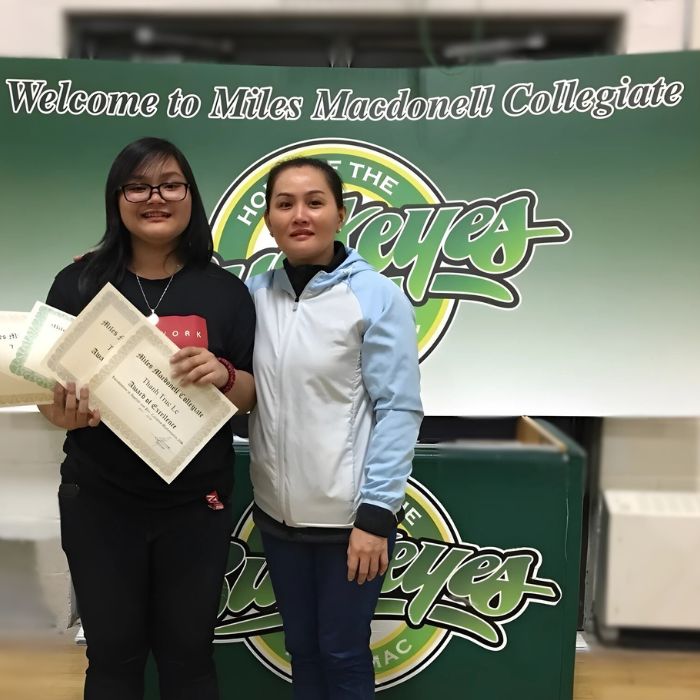
Lê Thanh Trúc, Student at Miles Macdonell Collegiate
“My family and I are deeply grateful to SIEC for not only securing my **Canada high school student visa** in Grade 10 but also for assisting my parents and siblings in obtaining their **visitor visas**. That was an invaluable gift.” — Lê Thanh Trúc, Student at **Miles Macdonell Collegiate** Secure Your Early High School (Secondary) […]
Phan Thị Ngọc Huỳnh, Former Student in Winnipeg
“The solid foundation provided by SIEC and Ms. Huong not only helped me realize my study abroad dream but also gave me the confidence to graduate, secure a stable job, and **settle permanently in Canada**.” — Phan Thị Ngọc Huỳnh, Former Student, currently working in **Winnipeg, Canada** Explore Your Study & Immigration Pathway in Canada […]
Hoàng Giang, Student at Edmonds College
“With her dedication and passion, Ms. Huong helped launch my **American dream**, opening up a vast world of opportunity and the chance to meet new friends.” — Hoàng Giang, Student at **Edmonds College** Explore More About Studying in the USA Spotlight on Edmonds College (Washington State) Gain in-depth knowledge about the programs, tuition fees, and […]
Khánh Lê, Student at LaSalle College
“Thank you to Ms. Huong and the SIEC team for their dedicated partnership and support, from my application phase until I was settled in Canada, helping me confidently pursue my dreams.” — Khánh Lê, Student at **LaSalle College** Explore Further Canada Study Opportunities Spotlight on LaSalle College Gain deeper insights into the programs, tuition fees, […]
Quỳnh Giao, Student at Red River Colleg
“She didn’t just stop at completing the application; she was an inspiration, a true motivator…” — Quỳnh Giao, Student at **Red River College** Continue Your Canada Study Abroad Journey Spotlight on Red River College Polytechnic (RRC Polytech) Discover the high-demand, **applied learning programs** at **Red River College** – one of the premier post-secondary institutions in […]