How to Calculate High School GPA for Studying in the USA
29/08/2026 Phong Nguyen
Understanding how to calculate high school GPA for studying in the U.S. is the first and most crucial step for any student dreaming of the land of opportunity. The Cumulative Grade Point Average (GPA) is not just a number representing academic ability but also the key to unlocking high-value scholarship opportunities. In the context of the 2026–2027 admission cycle, parents and students need a more strategic perspective, looking beyond just attending school to considering a long-term roadmap through the Double-Path strategy. This is a perfect combination of hunting for scholarships for the Fall 2027 intake and preparing for the EB-3 employment-based settlement pathway to ensure a stable career future in the U.S.
Overview of how to calculate high school GPA for studying in the U.S.
In the U.S. education system, GPA is an indicator used to evaluate a student’s academic performance throughout three years of high school. For Vietnamese students, the method to calculate high school GPA for U.S. study is usually based on transcripts from Grade 10, Grade 11, and the first semester of Grade 12. U.S. universities look at a student’s progress over the years to evaluate their effort and ability to adapt to a rigorous academic environment.
Each U.S. university may have different minimum requirements, but generally, a GPA of 3.0 or higher on a 4.0 scale is considered safe for applying to prestigious public universities. For students aiming for Fall 2027 scholarships at Ivy League or renowned private schools, the required GPA is usually between 3.8 and 4.0. Mastering how to calculate high school GPA helps students self-assess their abilities and choose a school that fits their financial capacity and career goals.
In addition to classroom grades, U.S. universities are also interested in the rigor of the courses students choose. If you study international programs such as IB, AP, or A-Level, the way to calculate high school GPA will have certain differences through a bonus point system. This helps highlight your profile among thousands of other applicants in the upcoming U.S. study abroad 2026-2027 admission cycle.
Guide on how to calculate high school GPA from a 10-point scale to a 4.0 scale
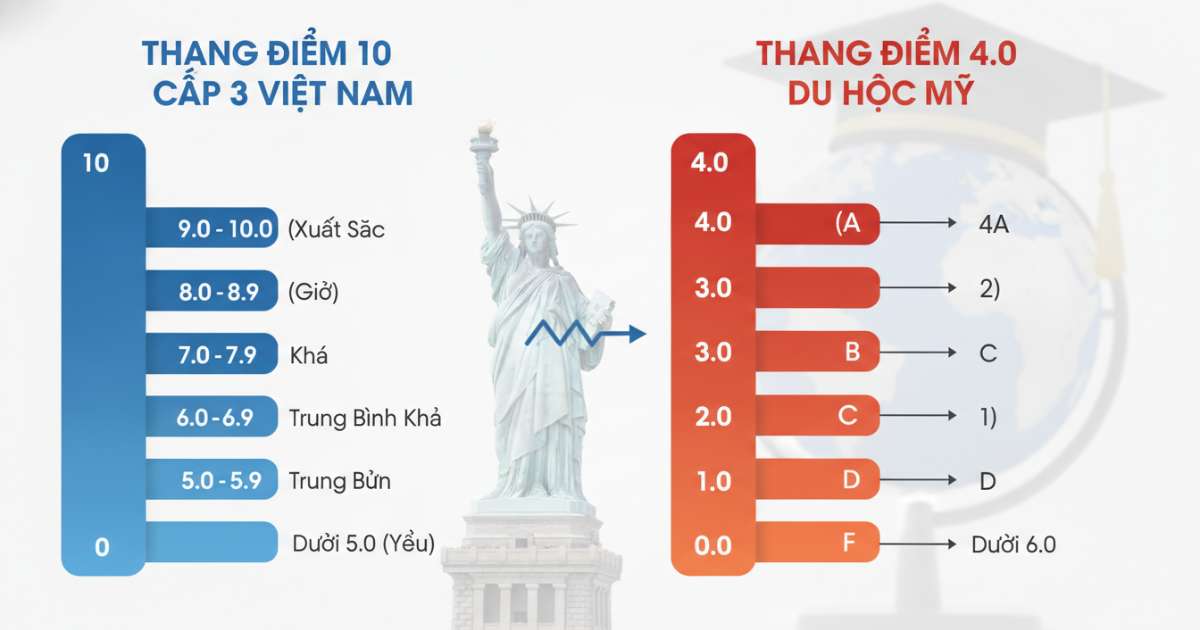
In Vietnam, high schools use a 10-point scale to evaluate students, while U.S. universities use a 4.0 scale. Therefore, conversion is a mandatory requirement for study abroad applications. The most common way to calculate high school GPA currently is to divide the average subject score by 2.5. For example, if your annual GPA is 8.0, it would be equivalent to 3.2 on the U.S. scale. However, this is only a relative calculation for quick reference.
To get more accurate results according to the standards of international education credentialing organizations like WES or NACES, the method to calculate high school GPA will be based on converting specific grade ranges. Typically, a score from 9.0 to 10 corresponds to an A (4.0), 8.0 to 8.9 corresponds to a B (3.0), and 7.0 to 7.9 corresponds to a C (2.0). This detailed conversion helps U.S. admissions officers better understand the actual academic performance of students within the Vietnamese educational environment.
Students should also note the difference between Unweighted GPA and Weighted GPA. Unweighted GPA is a method where all subjects carry the same weight on a 4.0 scale. Conversely, Weighted GPA adds bonus points for advanced courses, which can push the score up to 5.0. Understanding these two concepts will help you present your profile in the smartest way to attract the attention of the admissions committee during the U.S. study abroad 2026-2027 cycle.
Common conversion table for Vietnamese students
Average score from 9.0 – 10.0: Equivalent to 4.0 (A)
Average score from 8.0 – 8.9: Equivalent to 3.5 – 3.9 (B+ to A-)
Average score from 7.0 – 7.9: Equivalent to 3.0 – 3.4 (B)
Average score from 6.0 – 6.9: Equivalent to 2.0 – 2.9 (C)
Applying the correct method to calculate high school GPA helps students avoid unnecessary errors when filling out online applications. Additionally, you should proactively request official transcripts from your school and hire professional consulting units for translation and notarization to ensure the legal validity of your documents.
School selection strategy and Fall 2027 scholarship hunting based on scores
Once you know how to calculate high school GPA, the next step is to build a list of target universities. A smart school selection strategy usually includes three groups: dream schools (with GPA requirements slightly higher than current capacity), match schools, and safety schools. For the Fall 2027 scholarship cycle, competition will be intense, so students need to start preparing their applications early, at least by the end of Grade 11.
Scholarships in the U.S. are generally divided into two main types: Merit-based (based on ability) and Need-based (based on financial need). The way you calculate high school GPA plays a decisive role for Merit-based scholarship packages. If you possess an impressive GPA along with high SAT/ACT scores, the opportunity to receive financial support from 50% to 100% of tuition is entirely feasible. This is the best way to reduce the financial burden on the family when studying abroad.
Besides scores, U.S. universities also highly value extracurricular activities and personal essays. However, it cannot be denied that GPA is the first technical barrier. If you do not meet the minimum GPA requirement through the school’s method to calculate high school GPA, your application may be rejected in the first round. Therefore, maintaining stable academic performance throughout high school is a top priority.
Effective preparation of financial records and U.S. study visa interviews
Financial records are an inseparable part of the study abroad plan. After proving academic ability through the way you calculate high school GPA, parents need to prepare evidence of the ability to pay for tuition and living expenses for their children. Documents such as savings books, property deeds, labor contracts, or business licenses need to be arranged scientifically and transparently.
During the visa interview, the consular officer will ask many questions to verify the authenticity of the application. Students need to clearly explain how they calculate high school GPA if there are discrepancies between academic years. Confidence and honesty are the keys to passing this interview. You should practice answering questions about the reason for choosing the school, the study plan, and future intentions after graduation to demonstrate thorough preparation.
An important note is that financial records must match the information declared in the I-20 form issued by the school. If you receive a Fall 2027 scholarship, the actual amount needed for financial proof will be significantly reduced. This not only helps the family save costs but also creates a good impression on the visa officer regarding the student’s outstanding ability demonstrated through an excellent way to calculate high school GPA.
Building a clear study plan to avoid “unclear purpose” errors
One of the most common reasons students are denied a U.S. visa is the “unclear purpose” error. To avoid this, you need to build a detailed and logical study plan. This plan must show the connection between what you studied in high school, how you calculate high school GPA in specialized subjects, and your future career goals. The consular officer needs to see that you are coming to the U.S. to truly study and not for any other purpose.
The study plan should include information about the chosen major, the courses expected to be registered for, and the reason why the U.S. educational environment is necessary for your development. Clearly presenting how to calculate high school GPA helps prove that you have thoroughly researched the U.S. education system. A consistent study path from undergraduate to graduate school (if applicable) will make your application much more persuasive.
In the Double-Path strategy, the study plan must also be linked to long-term career orientation. You can mention wanting to intern at large corporations to gain experience before returning to contribute to your homeland, or if following the EB-3 settlement path, you need to skillfully express the desire to work in fields where the U.S. is facing labor shortages. Consistency in information will help you overcome tough questions from the consulate.
EB-3 settlement roadmap for Vietnamese international students in 2026
The Double-Path strategy that many families are currently aiming for is the combination of studying abroad and EB-3 settlement. This is a settlement category for skilled workers, professionals, or unskilled workers based on the sponsorship of a U.S. employer. For international students, after graduating with a solid knowledge base and an impressive way to calculate high school GPA, transitioning to an employment-based settlement category will become more favorable.
An overview of the EB-3 program shows that it is one of the most direct and safest ways to obtain a green card. However, as the volume of applications from Vietnam increases, waiting time is a factor that needs careful consideration. It is expected that in 2026, the processing time for EB-3 applications for Vietnamese citizens may range from 4 to 6 years depending on the timing and application category. Therefore, starting this roadmap while the student is still in university is a wise decision for parents.
When combining U.S. study abroad 2026-2027 and EB-3, students will have a great advantage in language and U.S. work culture. While waiting for the settlement application to be approved, students can still complete their studies and work under the OPT (Optional Practical Training) status. Knowing how to calculate high school GPA well will help you easily find jobs at reputable companies, thereby creating a solid foundation for future settlement sponsorship.
Waiting time and EB-3 implementation process in 2026
The EB-3 process usually includes three main stages: applying for a Labor Certification (LC) from the U.S. Department of Labor, filing form I-140 with the Immigration Service, and finally interviewing for an immigrant visa or adjusting residency status. For those following the U.S. study abroad 2026-2027 path, grasping the golden moment to file the application is extremely important to shorten the waiting time.
Stage 1: Find a reputable employer and file for Labor Certification (takes about 6-12 months).
Stage 2: File form I-140 after obtaining the LC (processing time from 6-15 months, premium processing available).
Stage 3: Wait for the Priority Date to file for the green card (this is the most time-consuming stage).
Parents need to understand that EB-3 settlement is not a short-term process. It requires perseverance and a long-term financial plan. However, the reward is a permanent green card for the whole family, opening up opportunities to work and live freely in the U.S. Skillfully combining study based on how you calculate high school GPA and a settlement roadmap will help your children have the most secure future.
Conclusion on the Double-Path strategy for U.S. study and settlement
The journey to conquer the American dream does not just stop at knowing how to calculate high school GPA or applying to any university. It is a long-distance race that requires careful calculation of both academics and settlement orientation. With the Double-Path strategy for U.S. study abroad 2026-2027, students not only gain access to a world-leading education but also have a clear path to becoming a U.S. permanent resident.
Investing in studies to achieve a high GPA through an accurate way to calculate high school GPA will help save costs thanks to Fall 2027 scholarships. At the same time, launching the EB-3 settlement roadmap early will help solve the problem of employment and residency after graduation. This is the long-term vision that every family should equip themselves with to help their children confidently step out into the world and build a sustainable career in the United States.
Start preparing today by practicing your studies and thoroughly researching immigration regulations. A perfect application does not just lie in the numbers found when you calculate high school GPA, but also in the determination and the right path you choose.
If you are wondering how to optimize your profile or need a safe EB-3 employment-based settlement roadmap, contact our team of experts immediately. SIEC is committed to accompanying parents and students in building a personalized Double-Path strategy, from the stage of converting scores to receiving the green card in hand.
Don’t let procedural barriers slow your progress on the path to America. Register for an in-depth consultation to receive detailed guidance on the most suitable scholarship programs and settlement roadmaps for your family’s conditions at SIEC https://siec.com.vn/dang-ky
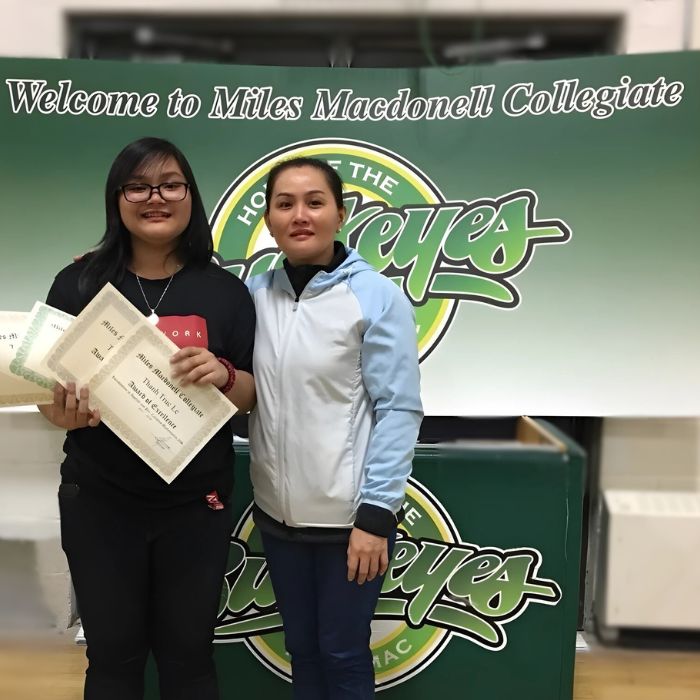
Lê Thanh Trúc, Student at Miles Macdonell Collegiate
“My family and I are deeply grateful to SIEC for not only securing my **Canada high school student visa** in Grade 10 but also for assisting my parents and siblings in obtaining their **visitor visas**. That was an invaluable gift.” — Lê Thanh Trúc, Student at **Miles Macdonell Collegiate** Secure Your Early High School (Secondary) […]
Phan Thị Ngọc Huỳnh, Former Student in Winnipeg
“The solid foundation provided by SIEC and Ms. Huong not only helped me realize my study abroad dream but also gave me the confidence to graduate, secure a stable job, and **settle permanently in Canada**.” — Phan Thị Ngọc Huỳnh, Former Student, currently working in **Winnipeg, Canada** Explore Your Study & Immigration Pathway in Canada […]
Hoàng Giang, Student at Edmonds College
“With her dedication and passion, Ms. Huong helped launch my **American dream**, opening up a vast world of opportunity and the chance to meet new friends.” — Hoàng Giang, Student at **Edmonds College** Explore More About Studying in the USA Spotlight on Edmonds College (Washington State) Gain in-depth knowledge about the programs, tuition fees, and […]
Khánh Lê, Student at LaSalle College
“Thank you to Ms. Huong and the SIEC team for their dedicated partnership and support, from my application phase until I was settled in Canada, helping me confidently pursue my dreams.” — Khánh Lê, Student at **LaSalle College** Explore Further Canada Study Opportunities Spotlight on LaSalle College Gain deeper insights into the programs, tuition fees, […]
Quỳnh Giao, Student at Red River Colleg
“She didn’t just stop at completing the application; she was an inspiration, a true motivator…” — Quỳnh Giao, Student at **Red River College** Continue Your Canada Study Abroad Journey Spotlight on Red River College Polytechnic (RRC Polytech) Discover the high-demand, **applied learning programs** at **Red River College** – one of the premier post-secondary institutions in […]