Guide to Vocational training Canada for Fast Settlement
14/04/2026 Phong Nguyen
Entering the 2026-2027 period, Canada’s immigration policy has undergone significant shifts, focusing strongly on attracting highly skilled workers in essential sectors. Instead of open-door immigration as in previous years, the government prioritizes individuals with expertise that meets the actual needs of the labor market. **Vocational training Canada** has become the shortest and most effective path for international students to access sustainable job opportunities.
Grasping the new regulations on finance, work permits, and the list of priority occupations will help you build a solid immigration roadmap in the Great White North.
1. Requirements for Vocational training Canada 2026
To embark on your **Vocational training Canada** journey in 2026, candidates must prepare a profile that meets stricter standards from Immigration, Refugees and Citizenship Canada (IRCC). A new focus in this phase is the consistency between your previous educational background and the chosen field of study in Canada.
Regarding academic qualifications, you must have at least graduated from high school with an above-average GPA. For Post-Graduate certificate programs, a College or University degree from your home country is mandatory. Vocational training Canada requires an English proficiency level of IELTS Academic 6.0 or higher, or equivalent certificates like PTE Academic, to ensure the ability to absorb specialized knowledge.
Furthermore, the Study Plan plays a decisive role. You need to clearly present the reasons for choosing that specific occupation and your plan to contribute to the Canadian labor market after graduation. Vocational training Canada is not just about studying; it is a process of preparing skills to join the country’s high-quality workforce.
1.1. Age and Health Requirements
Although Canada does not set a strict age limit for studying, the ideal age for a Vocational training Canada application is typically between 18 and 35. Older candidates need practical work experience closely related to their intended field of study to increase their Visa approval rate. Additionally, you must undergo a health examination at designated medical facilities and provide a clean criminal record.
2. New Financial Requirements for Vocational training Canada
Starting from 2025 and continuing into 2026, the financial proof requirement for international students has increased significantly to ensure a stable life. When choosing **Vocational training Canada**, you must demonstrate sufficient ability to cover the first year’s tuition and living expenses according to the latest IRCC regulations.
Expense Category
Estimated Amount (CAD)
Notes
Average Tuition Fees
15,000 – 22,000
Depending on the school and program
Cost of Living
21,000 – 23,000
Minimum IRCC requirement for 1 person
Insurance and other fees
1,500 – 2,500
Includes mandatory health insurance
First-year Total
37,500 – 47,500
Equivalent to approximately 700 – 900 million VND
Financial resources for **Vocational training Canada** must have a clear origin through savings books, bank statements, or other valuable assets. Solid financial preparation helps you focus entirely on your studies and reduces economic pressure during the initial period of settling into a new environment.
3. Study Permit Regulations and 24-hour Weekly Work Limit
A Study Permit is the most important document that allows you to reside legally in Canada. In the context of 2026-2027, maintaining active academic status is a prerequisite for keeping your Study Permit. An important change that those pursuing vocational training in Canada should note is the regulation on off-campus work hours.
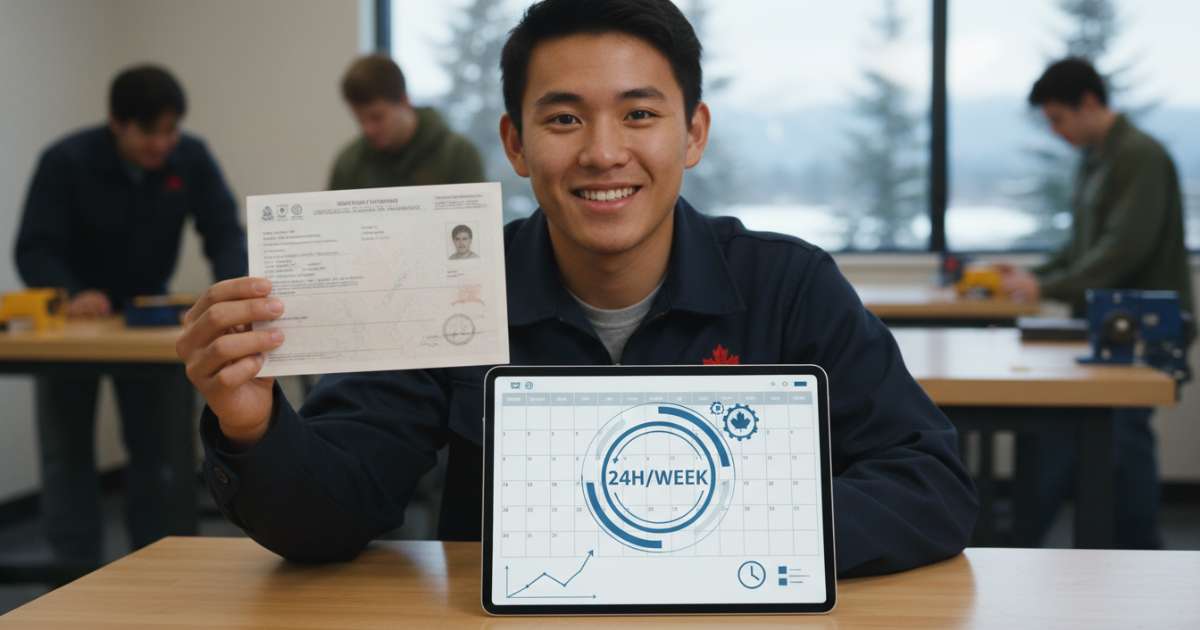
The Canadian government has officially applied a maximum limit of 24 hours of work per week during regular academic sessions. This regulation aims to help international students balance study and work, ensuring the quality of professional outcomes. During scheduled breaks or summer vacations, students can still work full-time to accumulate experience and income.
Violating work hour regulations can lead to serious consequences, such as revocation of the Study Permit or denial of a Post-Graduation Work Permit (PGWP). Therefore, when participating in vocational training in Canada, you must manage your time strictly and comply absolutely with federal rules to protect your long-term immigration pathway.
4. Priority Occupations for Immigration in Canada 2027
Canada’s immigration strategy in 2027 focuses on sectors facing severe labor shortages. Instead of choosing general economic fields, students should aim for sectors on the priority list to have a higher chance of receiving an invitation to apply for permanent residency through the Express Entry system or Provincial Nominee Programs (PNP).
4.1. Healthcare and Medical Sector
This sector tops the priority list due to Canada’s aging population. **Vocational training Canada** programs in Nursing, Personal Support Worker (PSW), Laboratory Technician, or Physiotherapy are in extremely high demand. Graduates in these fields often find employment immediately with attractive salaries and very open immigration pathways.
4.2. STEM and Information Technology
STEM, including Science, Technology, Engineering, and Mathematics, is the pillar of Canada’s economic development. Choosing vocational training in fields such as Software Programming, Data Analysis, Cybersecurity, or Mechanical Engineering will help you easily access large enterprises. Provinces like Ontario and British Columbia always have specific immigration streams for high-quality personnel in this group.
4.3. Construction and Skilled Trades
To address the housing crisis, Canada needs hundreds of thousands of workers in the construction sector. Vocational training courses in Electrical, Welding, Carpentry, Construction Management, or Heating, Ventilation, and Air Conditioning (HVAC) are becoming a trend. These are high-income occupations and are given special priority in skilled trade immigration draws.
5. Pathway from Vocational training Canada to Skilled Worker Immigration
To realize your immigration dream, you need a systematic plan from the start of your studies until you receive your Permanent Resident (PR) card. The most popular **Vocational training Canada** pathway includes four key stages that help you optimize your immigration score.
The first stage is completing your program at a Designated Learning Institution (DLI) that offers a PGWP. After graduation, you apply for a Post-Graduation Work Permit to stay and work in Canada for 1 to 3 years. During this time, accumulating work experience in a priority sector is the key to success when pursuing vocational training in Canada.
Once you have 1 year of Canadian work experience, you can apply for Express Entry under the Canadian Experience Class (CEC) or participate in Provincial Nominee Programs. With a foundation from **Vocational training Canada**, you will have advantages in language points, Canadian education level, and practical work experience, making your profile superior to candidates applying from abroad.
6. How to Choose the Right School and Program for Vocational training Canada
Choosing the right school and province when opting for **Vocational training Canada** determines 70% of your immigration success. You should prioritize Public Colleges because these institutions often have strong links with local businesses and ensure eligibility for a PGWP after graduation.
Thoroughly research the labor market of each province. For example, if you choose vocational training in Construction, provinces with strong infrastructure development like Alberta or Saskatchewan will be ideal destinations. Conversely, if pursuing Information Technology, Ontario or British Columbia will provide more internship and job opportunities.
At SIEC, we provide in-depth consulting services to help you analyze your potential and choose the most suitable pathway for your personal circumstances. **Vocational training Canada** is not just a course; it is an investment in your future. We are committed to accompanying you in profile evaluation, school selection, and preparing necessary legal procedures for the smoothest immigration process.
The journey to conquer Canada in 2027 requires careful preparation and a deep understanding of new immigration laws. Do not let policy changes be a barrier to your dreams. Proactively seek support from experienced experts to optimize your chances of success.
Contact SIEC today for detailed advice on your vocational training roadmap in Canada and receive an in-depth assessment of your immigration potential for the 2026-2027 period. We are always ready to answer any questions and support you in completing your profile most professionally.
Evaluate your Canada 2027 immigration potential today to not miss out on the best scholarships and job opportunities at https://siec.com.vn/dang-ky
Are You Ready to Break Through Your Global Career with SIEC?
Don’t let your prestigious degree just stay on paper. Let SIEC experts advise you on a study abroad roadmap combined with a strategic career orientation starting today!
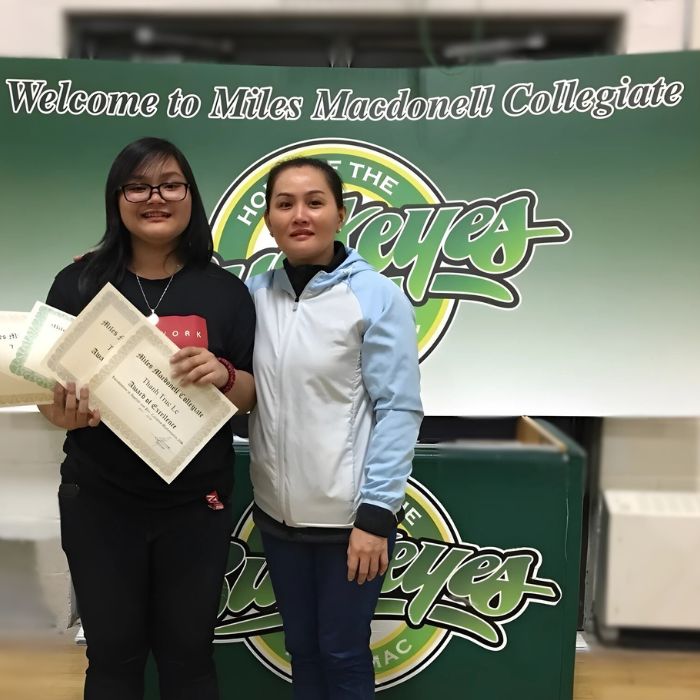
Lê Thanh Trúc, Student at Miles Macdonell Collegiate
“My family and I are deeply grateful to SIEC for not only securing my **Canada high school student visa** in Grade 10 but also for assisting my parents and siblings in obtaining their **visitor visas**. That was an invaluable gift.” — Lê Thanh Trúc, Student at **Miles Macdonell Collegiate** Secure Your Early High School (Secondary) […]
Phan Thị Ngọc Huỳnh, Former Student in Winnipeg
“The solid foundation provided by SIEC and Ms. Huong not only helped me realize my study abroad dream but also gave me the confidence to graduate, secure a stable job, and **settle permanently in Canada**.” — Phan Thị Ngọc Huỳnh, Former Student, currently working in **Winnipeg, Canada** Explore Your Study & Immigration Pathway in Canada […]
Hoàng Giang, Student at Edmonds College
“With her dedication and passion, Ms. Huong helped launch my **American dream**, opening up a vast world of opportunity and the chance to meet new friends.” — Hoàng Giang, Student at **Edmonds College** Explore More About Studying in the USA Spotlight on Edmonds College (Washington State) Gain in-depth knowledge about the programs, tuition fees, and […]
Khánh Lê, Student at LaSalle College
“Thank you to Ms. Huong and the SIEC team for their dedicated partnership and support, from my application phase until I was settled in Canada, helping me confidently pursue my dreams.” — Khánh Lê, Student at **LaSalle College** Explore Further Canada Study Opportunities Spotlight on LaSalle College Gain deeper insights into the programs, tuition fees, […]
Quỳnh Giao, Student at Red River Colleg
“She didn’t just stop at completing the application; she was an inspiration, a true motivator…” — Quỳnh Giao, Student at **Red River College** Continue Your Canada Study Abroad Journey Spotlight on Red River College Polytechnic (RRC Polytech) Discover the high-demand, **applied learning programs** at **Red River College** – one of the premier post-secondary institutions in […]