Guide to the GPA requirements for US top-tier colleges
28/08/2026 Phong Nguyen
When starting to research the path to studying in the Land of Opportunity, the first question parents and students often ask is what are the GPA requirements for US universities to be admitted to quality institutions. The Grade Point Average, or GPA, serves as the most important measure of proficiency in an academic profile. However, in the current context, focusing solely on grades is no longer enough. The new trend for the 2026–2027 period is the Double-Path strategy, a roadmap that combines intensive study with a long-term immigration orientation through employment-based residency. This article will provide a detailed analysis of grade requirements, profile building, and the optimal roadmap for families to have the most comprehensive view.
What are the GPA requirements for US universities to optimize school selection?
Each university in the US has its own distinct admission standards, but generally, the answer to the question of **GPA requirements for US** schools will depend on the school segment the student is targeting. For top-tier schools or the Ivy League group, a near-perfect GPA of 3.8 to 4.0 is a mandatory condition to be competitive. In this segment, admissions committees do not just look at the overall number but also carefully examine grades in core subjects related to the student’s registered major.
Grade requirements at mid-range public and private universities
For the majority of state public universities or private schools ranked between 50 and 100, the average grade usually ranges from 3.0 to 3.5. This is a safe threshold that gives students many choices regarding majors and study locations. If you are wondering about the GPA requirements for US community colleges, the answer is usually easier, requiring only a 2.0 or higher. Community colleges are an excellent stepping stone for those whose scores are not yet high but who still want to pursue the American dream through a university transfer roadmap.
Differences in GPA between STEM and Economics sectors
Majors in the STEM block, such as engineering, information technology, or data science, often require higher GPA levels in math and natural sciences. Conversely, majors in economics or the arts may be more flexible regarding grades if students possess outstanding talents or extracurricular activities. Understanding the specific **GPA requirements for US** programs in each field will help students focus on improving the right target grades, avoiding the unnecessary spreading of resources during their final high school years.
The connection between hunting for Fall 2027 scholarships and GPA requirements for US studies
Hunting for scholarships for the Fall 2027 intake requires long-term preparation, and GPA is the key to opening the financial door. To receive scholarships ranging from 30% to 100% of tuition, students need to maintain an impressive transcript, usually 3.5 or higher. When reviewing scholarships, schools will compare the capacity of candidates based on the question of what the **GPA requirements for US** institutions are to be worthy of their support budget. The higher the GPA, the greater the student’s ability to negotiate scholarships, helping to reduce financial pressure on the family.
Academic performance maintenance tactics for Fall 2027
Students need to start improving their grades as early as 10th and 11th grade. US universities highly value academic progress. If your scores tend to increase over the years, it is a positive signal showing adaptability and persistent effort. In the scholarship hunting roadmap, the issue of **GPA requirements for US** admissions is not just a static number but a process of proving cognitive ability. Besides, combining a high GPA with standardized test scores like the SAT or ACT will create an extremely persuasive profile for the admissions committee.
The role of grades in maintaining scholarships after admission
Many students mistakenly believe that achieving a high score to study abroad is enough. In reality, most scholarship packages in the US come with a condition to maintain the GPA at a certain level, usually 3.0 or higher throughout the study process. Therefore, knowing the GPA requirements for US schools to keep a scholarship is just as important as achieving the score to be admitted. This requires international students to have self-discipline and scientific study methods right from their time in Vietnam so as not to be overwhelmed by the new educational environment.
Completing financial profiles and study plans to avoid “unclear purpose” errors
One of the most common reasons for visa rejection is the error of unclear study purpose. To overcome this, students need to build a detailed study plan, clearly showing the link between their studies in Vietnam and their intended major in the US. When presenting this plan, mentioning the **GPA requirements for US** schools and how you have strived to achieve that score will demonstrate your seriousness. The study plan must point out the reasons for choosing the school, the major, and the logical career intentions after graduation.
Financial records need to be prepared transparently and fully. Families need to prove a stable source of income and accumulated assets sufficient to pay for the entire duration of study. However, strong finances cannot replace academic capacity. Consular officers will still consider whether you meet the **GPA requirements for US** education to assess if the student is truly going to the US to study or just using the guise of studying for another purpose. The combination of a beautiful transcript and a solid financial profile is the best foundation for a successful application.
Building a clear academic roadmap for the future
A persuasive study plan needs to answer the question of why you are not studying that major in Vietnam but must go to the US. You need to clearly state the advantages of the training program in the US and how it helps you achieve your personal goals. In this section, reiterate that you have researched the **GPA requirements for US** universities to choose the school that best fits your ability. Careful preparation of information will help you be more confident when facing questioning from the authorities.
Visa interview experience based on actual academic capacity
The visa interview is the turning point that decides the success or failure of the entire preparation process. Consular officers often focus on English communication skills and the student’s understanding of the study program. When asked about academic results in Vietnam, you should confidently present your scores. Understanding the GPA requirements for US colleges to be accepted will help you explain why you are a suitable candidate. Answer honestly, briefly, and focus on your most outstanding academic achievements.
Handling difficult questions about grades and study goals
If your GPA is not very high, do not worry too much. Focus on explaining the subjects you are strong in or the extracurricular activities that helped you compensate for the scores. The important thing is that you must show a passion for your chosen major. Consular officers care about whether you truly understand the GPA requirements for US institutions to maintain your studies in the US. Show them that you have prepared mentally and have a study method to overcome challenges in an international university environment.
Confident mindset and thorough preparation of school information
Students should master information about the school, such as the address, main subjects, the principal’s name, or prominent features of the state they are going to. This understanding proves that you have spent time conducting serious research. When you present that you have searched for information on **GPA requirements for US** applications, it shows that you have a clear roadmap and do not depend entirely on consulting units. Proactivity is always highly valued in US visa interviews.
Double-Path strategy and EB-3 immigration overview for Vietnamese people
The Double-Path strategy is a smart direction for families with a long-term vision for the 2026–2027 period. This is a combination of sending children to study abroad and simultaneously processing an EB-3 employment-based immigration profile. With this roadmap, the question of **GPA requirements for US** education remains important to ensure academic success, but in parallel, the family will prepare a Green Card so that the student has the right to work and reside legally after graduation. EB-3 is an immigration program for skilled workers, professionals, or unskilled workers, encouraged by the US government to address labor shortages.
Advantages of combining study abroad and EB-3 labor immigration
When holding a Green Card through the EB-3 category, international students will enjoy tuition rates equivalent to domestic residents, which are much lower than tuition for international students. Furthermore, after graduation, students no longer have to worry about applying for the risky H-1B work visa or being limited in their stay in the US. Early preparation from 2026 will help optimize the waiting time. While students are striving to meet the **GPA requirements for US** schools, the immigration file is also being processed, creating a solid stepping stone for the future.
Conditions and subjects participating in the EB-3 program
The EB-3 program does not have high requirements for degrees or experience for the unskilled labor category, but it requires a commitment to work for the US employer for a certain period. For young people interested in the **GPA requirements for US** studies, knowing about EB-3 opens a new door to realizing the dream of settlement. This is a safe and highly legal option, helping to thoroughly solve the problem of employment and settlement for Vietnamese people in the coming years.
EB-3 waiting time in 2026 and the long-term roadmap for international students
One of the most important factors when pursuing the Double-Path strategy is understanding the waiting time. For Vietnamese people, EB-3 processing time can last several years depending on the Visa Bulletin from the US Department of State. It is predicted that in 2026, waiting times may fluctuate based on the backlog of applications and annual quotas. Starting the application now, at the same time as researching **GPA requirements for US** intake for Fall 2027, is a wise calculation to ensure the milestones align perfectly.
EB-3 application process and important stages
The EB-3 process usually goes through three main stages: applying for a labor certification from the Department of Labor (PERM), filing an immigration petition with USCIS (I-140), and finally waiting for an interview at the Consulate or adjusting status in the US. Throughout this time, students can still maintain their normal studies. Mastering the **GPA requirements for US** graduation with good results will help candidates have a better profile when transitioning to official immigration status. Patience and compliance with the legal process are the keys to achieving the prestigious Green Card.
Vision for Vietnamese international students in the 2026–2027 period
The 2026–2027 period is predicted to see many changes in US immigration and education policies. Preparing a good academic foundation with an impressive GPA will help international students integrate confidently. When combined with the EB-3 roadmap, they will have a more solid mindset compared to those who only study abroad. The question of **GPA requirements for US** schools is now not just for studying, but to affirm one’s value in a competitive American society. Investing in education combined with immigration is the most profitable investment for the future of the younger generation.
The journey to conquer the American dream requires careful preparation from the smallest details like GPA scores to long-term strategies like EB-3 immigration. We hope the article has provided you with a clear view of the **GPA requirements for US** studies and how to build an effective Double-Path roadmap. Start planning today so as not to miss precious opportunities in the future.
To receive in-depth advice on the roadmap for studying abroad combined with US EB-3 immigration for the 2026–2027 period, parents and students should contact the team of experts at SIEC immediately. We will help you evaluate your profile capacity, answer detailed questions about grades, and build the most optimal financial and study plan.
Do not let information barriers slow your progress on the path to reaching the world. Let SIEC accompany you in realizing your goals of studying and settling in the Land of Opportunity safely and sustainably.
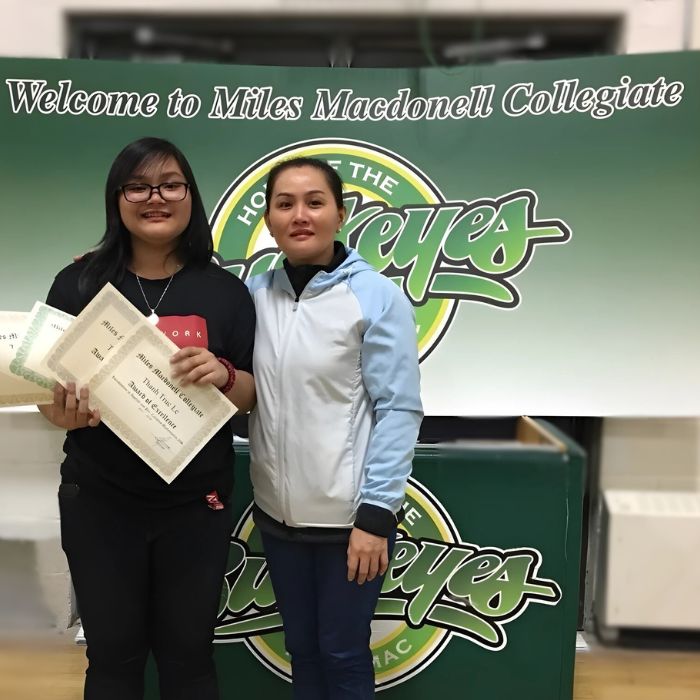
Lê Thanh Trúc, Student at Miles Macdonell Collegiate
“My family and I are deeply grateful to SIEC for not only securing my **Canada high school student visa** in Grade 10 but also for assisting my parents and siblings in obtaining their **visitor visas**. That was an invaluable gift.” — Lê Thanh Trúc, Student at **Miles Macdonell Collegiate** Secure Your Early High School (Secondary) […]
Phan Thị Ngọc Huỳnh, Former Student in Winnipeg
“The solid foundation provided by SIEC and Ms. Huong not only helped me realize my study abroad dream but also gave me the confidence to graduate, secure a stable job, and **settle permanently in Canada**.” — Phan Thị Ngọc Huỳnh, Former Student, currently working in **Winnipeg, Canada** Explore Your Study & Immigration Pathway in Canada […]
Hoàng Giang, Student at Edmonds College
“With her dedication and passion, Ms. Huong helped launch my **American dream**, opening up a vast world of opportunity and the chance to meet new friends.” — Hoàng Giang, Student at **Edmonds College** Explore More About Studying in the USA Spotlight on Edmonds College (Washington State) Gain in-depth knowledge about the programs, tuition fees, and […]
Khánh Lê, Student at LaSalle College
“Thank you to Ms. Huong and the SIEC team for their dedicated partnership and support, from my application phase until I was settled in Canada, helping me confidently pursue my dreams.” — Khánh Lê, Student at **LaSalle College** Explore Further Canada Study Opportunities Spotlight on LaSalle College Gain deeper insights into the programs, tuition fees, […]
Quỳnh Giao, Student at Red River Colleg
“She didn’t just stop at completing the application; she was an inspiration, a true motivator…” — Quỳnh Giao, Student at **Red River College** Continue Your Canada Study Abroad Journey Spotlight on Red River College Polytechnic (RRC Polytech) Discover the high-demand, **applied learning programs** at **Red River College** – one of the premier post-secondary institutions in […]