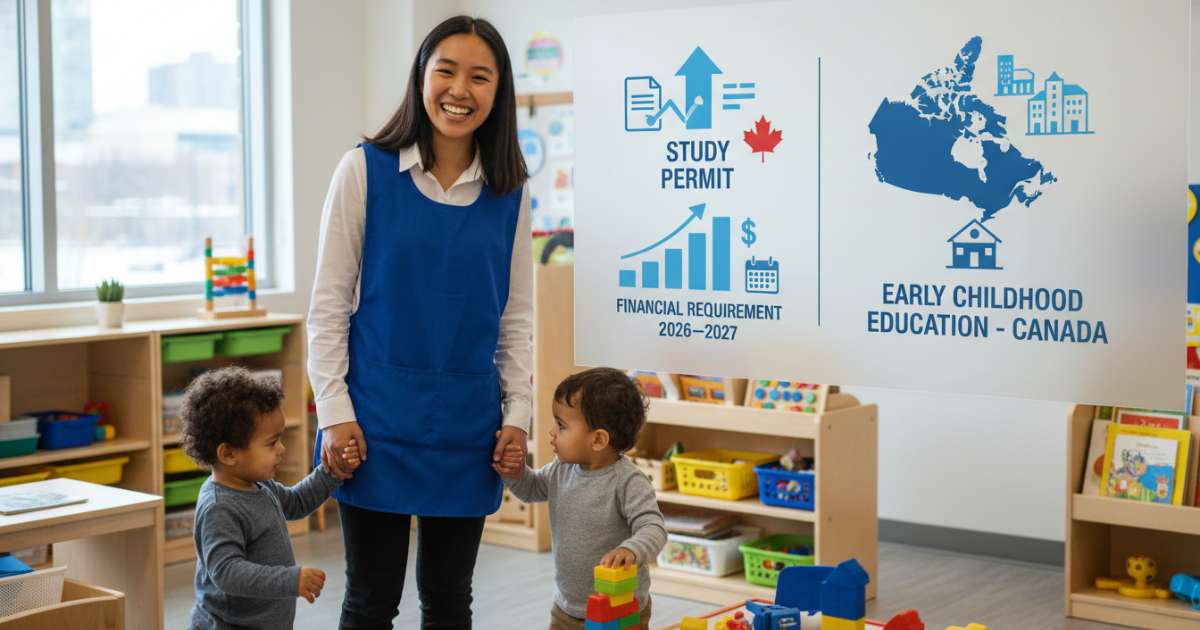
Early Childhood Education Canada: Study and PR Career Path
14/05/2026 Phong Nguyen
In the context of significant shifts in Canada’s immigration policies for the 2026–2027 period, choosing a field of study is no longer just about personal preference but must align with the actual demands of the labor market. The Canadian government is currently prioritizing essential sectors such as Healthcare, STEM, Construction, and especially Education. Among these, **Early Childhood Education Canada** is emerging as a strategic direction for international students due to vast job opportunities and a clearly prioritized pathway to permanent residency.
Instead of competing in general immigration streams that are being tightened, pursuing **Early Childhood Education Canada** positions you within a highly sought-after group across almost every province.
1. Why Choose Early Childhood Education Canada for the 2026–2027 Period
The 2026–2027 phase marks a major shift in Canada’s approach to immigration. Instead of granting Permanent Residency (PR) to all graduates, the country is focusing on Category-based selection programs. Early Childhood Education (ECE) is on the list of top-priority occupations.
When you decide to pursue **Early Childhood Education Canada**, you are investing in a field where Canada is facing a severe labor shortage due to rising birth rates in certain regions and government policies supporting childcare tuition for local residents.
Furthermore, studying this field brings career stability. Unlike the business or management sectors, which are often heavily influenced by market fluctuations, early childhood education is an essential service. Childcare centers, kindergartens, and community organizations always require a team of professionally qualified teachers.
Possessing a degree in this field from a reputable institution will be the “passport” that helps you easily find employment immediately after graduation, meeting the requirements of skilled immigration programs.
2. Documentation and Entry Requirements for Early Childhood Education Canada
To prepare for your journey in **Early Childhood Education Canada**, students must meet academic standards and soft skill requirements. Typically, colleges and universities in Canada require applicants to have graduated from high school with a Grade Point Average (GPA) of above average or higher. For this major, patience, communication skills, and a love for children are indispensable factors, sometimes evaluated through personal essays or direct interviews.
Regarding language proficiency, this is a mandatory requirement to ensure you can absorb knowledge and intern in professional educational environments. Most programs require an IELTS Academic score of 6.0 to 6.5 (with no band under 6.0) or equivalent certificates such as PTE Academic. Additionally, a unique point when applying is that you may need to provide a criminal record check and immunization records as per regulations to ensure safety when working directly with children during internships.
2.1. Degree and Professional Certification Requirements
When studying **Early Childhood Education Canada**, you will be trained to obtain certifications such as Early Childhood Educator (ECE) Assistant or ECE Level 1, 2, or 3, depending on the duration of study. Completing these levels is a prerequisite for being allowed to practice in Canada. Provinces like British Columbia or Ontario have their own regulations regarding professional licensing; therefore, students should pay attention to choosing a school with a curriculum that meets the specific standards of that province.
2.2. Health Check and Criminal Record
Due to the nature of the job involving contact with sensitive subjects like children, applications for this field require absolute transparency regarding background. Students must ensure they have no criminal record and are in good health, free from infectious diseases. This is a critical part of the school’s admission process and is also a requirement from immigration authorities when you apply for a post-graduation work permit related to your studies.
3. New Study Permit Regulations and Financial Requirements 2026–2027
Starting from 2024 and extending into the 2026–2027 period, Immigration, Refugees and Citizenship Canada (IRCC) has applied stricter regulations for Study Permits. Students wishing to pursue **Early Childhood Education Canada** must receive a Provincial Attestation Letter (PAL) before applying for a visa, with few exceptions. This aims to control the number of international students and ensure the quality of education.
Therefore, early planning for your educational pathway is extremely important to ensure you secure a spot at a reputable institution.
Financial requirements have also changed significantly. Students today need to prove a higher financial capacity than in previous years. In addition to tuition fees, the minimum cost of living requirement set by IRCC has increased to reflect the actual cost of living in Canada.
Preparing a transparent and clear financial profile is the key to obtaining a Study Permit. You need to prove a stable source of funds from family or individuals to cover the entire process of studying and living here.
Tuition Fees
Ranges from 15,000 to 20,000 CAD per year depending on the school and province for Early Childhood Education.
Living Expenses
Approximately 20,635 CAD (latest reference level) is needed for one year of living in Canada.
Proof of Funds
Savings accounts, monthly income of the sponsor, and other assets are the basis for evaluating study applications.
4. 24-Hour Weekly Work Regulation for International Students
An important change directly affecting students of **Early Childhood Education Canada** is the regulation on part-time work hours. Instead of being allowed to work unlimited hours as during the pandemic, since 2024, Canada has standardized off-campus work hours to 24 hours per week during academic sessions. This regulation helps students focus better on their studies while still having the opportunity to earn extra income and accumulate local work experience.
For students in this field, working part-time at childcare centers or after-school clubs not only provides income but is also an excellent opportunity to practice the language and better understand Canadian educational culture. This work experience will enhance your resume after graduation. During holidays or summer breaks, you are still permitted to work full-time to optimize your income.
5. How to Choose a Program and School for Early Childhood Education Canada
Choosing a school should be based on three main criteria: the DLI (Designated Learning Institutions) list, the eligibility for a PGWP (Post-Graduation Work Permit), and the province’s labor demand. Not every school offering this major will help you obtain a work permit after graduation. Therefore, before enrolling, you must carefully check the information on the Canadian government website to ensure the program is PGWP-eligible.
Provinces like Ontario, British Columbia, Alberta, and Saskatchewan are often ideal destinations for this field. Each location has its own immigration priorities. For example, British Columbia often has specific invitation rounds for early childhood educators with lower point requirements than other sectors.
When choosing a school, prioritize those with integrated internship (co-op) programs, as this is the fastest way to connect with employers and seek official job opportunities later on.
5.1. Reputable Colleges for Early Childhood Education
Many public colleges in Canada are famous for high-quality programs, such as Seneca College, George Brown College (Ontario), or Douglas College and Langara College (British Columbia). These schools often have close links with local childcare centers, making it easier for students to find internship placements and jobs after graduation.
5.2. Choosing a Province Based on Immigration Goals
If your goal is quick immigration, consider studying in provinces with strong policies to attract educational personnel. Alberta or the Atlantic provinces often have flexible Provincial Nominee Programs (PNP) for graduates from essential sectors. Researching the immigration pathway of each province before deciding will save you time and increase your success rate.
6. Roadmap from Study to Work and Permanent Residency in Canada 2027
A typical roadmap for students of **Early Childhood Education Canada** begins with completing a 2 to 4-year program. After graduation, you will apply for a PGWP to stay and work in Canada for a period equivalent to your study time (up to 3 years). During this time, accumulating work experience in your field is a prerequisite for moving towards permanent residency.
By 2027, immigration programs such as Express Entry through Category-based draws will continue to prioritize those with experience in the education sector. Students only need at least one year of work experience in Canada to have a very high chance of receiving an invitation for PR. Additionally, provincial nomination programs for the “Care Economy” group are also an open path for those who have completed their studies and are working in labor-shortage areas.
The biggest difference in the roadmap for this field compared to others is priority. While other general occupations face extremely high competitive scores, early childhood education is always classified as a sector that needs to be preserved and developed. This ensures that your efforts in studying and working will be worthily rewarded with a stable future in the Maple Leaf country.
To succeed in this journey, you need to maintain academic performance, actively participate in practical activities, and continuously improve your language skills. Understanding the education system and child safety regulations in Canada while you are still studying will help you become a prime candidate in the eyes of employers and immigration authorities.
The journey of **Early Childhood Education Canada** is not just about conquering an international degree but is also a smart strategy to build a career and sustainable residency. With the changes in immigration policy for the 2026–2027 period, choosing a priority profession like early childhood education will help you minimize risks and optimize your chances of becoming a Canadian permanent resident. Do not miss this golden time to start your plan.
If you are concerned about your application or want to learn more about reputable training schools, start your preparation today. Having the most accurate and updated information about the field will be the key to helping you feel more confident on the path to conquering your Canadian dream.
Let us accompany you in analyzing your profile and building the most optimal study roadmap. The opportunity for residency through the pathway of **Early Childhood Education Canada** is more open than ever for those who are well-prepared and determined to pursue this noble profession.
Contact us now to get support from experienced consultants in choosing a school, preparing visa applications, and long-term career orientation. This major is a solid stepping stone for your future in one of the most livable countries in the world.
Assess your 2027 Canada immigration potential now so you don’t miss out on scholarships and priority positions in the Early Childhood Education sector. The team of experts at SIEC is always ready to listen and provide the most suitable solutions for your financial conditions and academic ability.
Don’t let policy changes be a barrier to your dreams. With dedicated guidance, your study roadmap will become clearer and more feasible than ever. Start your life-changing journey today!
Are you looking for a sustainable study route with high residency potential in Canada in the coming years? Do not hesitate to connect with the professional consulting team at SIEC for the latest updates on visa policies and priority immigration programs for the education sector.
We will help you evaluate your profile, choose a school that fits your ability, and support you throughout the process from application to the moment you set foot in Canada. Let your dream of **Early Childhood Education Canada** become a reality with our specialized and dedicated support.
Are You Ready to Break Through Your Global Career with SIEC?
Don’t let your prestigious degree just stay on paper. Let SIEC experts advise you on a study roadmap combined with a strategic employment orientation starting today!
Lê Thanh Trúc, Student at Miles Macdonell Collegiate
“My family and I are deeply grateful to SIEC for not only securing my **Canada high school student visa** in Grade 10 but also for assisting my parents and siblings in obtaining their **visitor visas**. That was an invaluable gift.” — Lê Thanh Trúc, Student at **Miles Macdonell Collegiate** Secure Your Early High School (Secondary) […]
Phan Thị Ngọc Huỳnh, Former Student in Winnipeg
“The solid foundation provided by SIEC and Ms. Huong not only helped me realize my study abroad dream but also gave me the confidence to graduate, secure a stable job, and **settle permanently in Canada**.” — Phan Thị Ngọc Huỳnh, Former Student, currently working in **Winnipeg, Canada** Explore Your Study & Immigration Pathway in Canada […]
Hoàng Giang, Student at Edmonds College
“With her dedication and passion, Ms. Huong helped launch my **American dream**, opening up a vast world of opportunity and the chance to meet new friends.” — Hoàng Giang, Student at **Edmonds College** Explore More About Studying in the USA Spotlight on Edmonds College (Washington State) Gain in-depth knowledge about the programs, tuition fees, and […]
Khánh Lê, Student at LaSalle College
“Thank you to Ms. Huong and the SIEC team for their dedicated partnership and support, from my application phase until I was settled in Canada, helping me confidently pursue my dreams.” — Khánh Lê, Student at **LaSalle College** Explore Further Canada Study Opportunities Spotlight on LaSalle College Gain deeper insights into the programs, tuition fees, […]
Quỳnh Giao, Student at Red River Colleg
“She didn’t just stop at completing the application; she was an inspiration, a true motivator…” — Quỳnh Giao, Student at **Red River College** Continue Your Canada Study Abroad Journey Spotlight on Red River College Polytechnic (RRC Polytech) Discover the high-demand, **applied learning programs** at **Red River College** – one of the premier post-secondary institutions in […]