The tragedy of a ‘sure-win’ profile suffering a harsh rejection and the spectacular comeback achieved by changing the interview strategy. If you are lost and seeking an optimal solution for your journey, this is the story for you.
“Click!” – The cold sound of a stapler echoed behind the thick glass of window 5. Entering a US visa interview for the second consecutive time, I heard the familiar words: “I’m sorry, you are not qualified today.” Holding the rejection paper under Section 214(b) of the US Immigration and Nationality Act, my mind went blank. The only question repeating in my head was: What to do after a US visa rejection?
It felt like a freefall. I was a former specialized school student, GPA 9.2, SAT 1480, IELTS 8.0, from a family with a transparent business—yet I failed again. Was the dream of studying abroad closed forever? If you are also standing on the edge of despair, struggling with the dilemma of what to do after a US visa rejection, my journey of reviving my US visa interview script is the roadmap to help you reshape your entire future strategy.
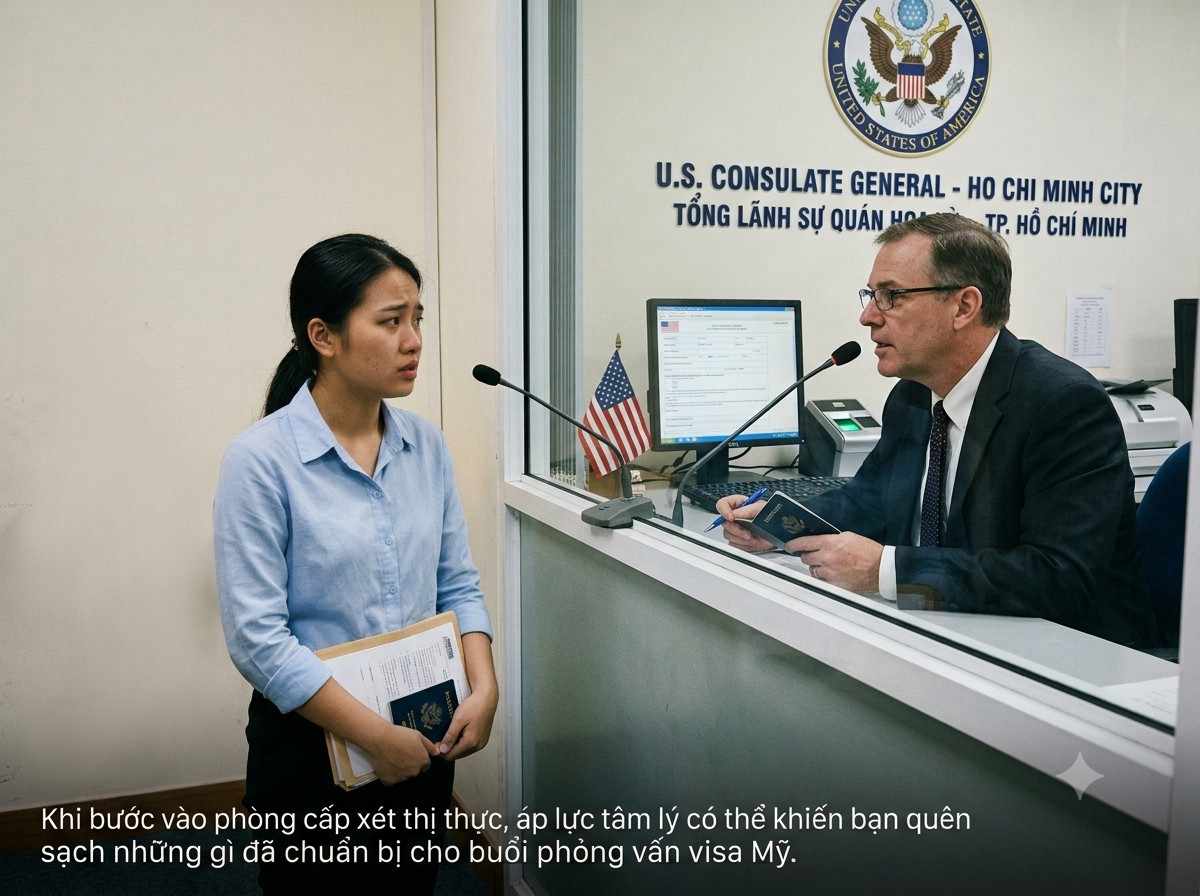
1. Anatomy of the Consular Officer’s Psychology & The Nature of Section 214(b)
When preparing for a US visa interview, most of us focus all our efforts on perfecting the paperwork, forgetting to study the psychology of the person on the other side. There is a harsh truth: A US visa interview is not an academic exam to be graded, but actually a high-stakes psychological battle within a very short timeframe. Many students, after receiving disappointing results, often search online asking what to do after a US visa rejection, but receive emotional, scientifically unfounded advice, making their next attempt even more deadlocked.
According to US legal regulations, Consular Officers (COs) are required to operate on the presumption that every non-immigrant visa applicant intends to stay in the US illegally. Section 214(b) is the legal barrier protecting this presumption. Your task in a US visa interview is to provide logical, persuasive evidence to break that presumption, proving you possess unbreakable ties to your home country.
Put yourself in the shoes of a CO: They have to process 100 to 150 files a day, with an average of only 2 to 3 minutes per applicant. They are tired, under pressure, and must make decisions based on sharp intuition combined with information displayed on the DS-160 system screen. If your answers are scripted, parrot-like, or hesitant, their defensive systems will immediately activate, leading to a denial. Therefore, the answer to what to do after a US visa rejection is not about submitting more documents, but about how to change the way you convey information in the first few seconds of the conversation.
2. Crisis After Rejection – What To Do In The First 24 Hours?
When facing failure, our common reaction is panic, anger, and seeking immediate comfort. However, if you want to turn the tables, the 24-hour period after rejection is the golden time to take strategic salvage measures. Instead of wallowing in disappointment and wondering what to do after a US visa rejection, immediately follow the strict three-step process below.
Step 1: The Transcription Protocol
As soon as you step out of the consular office, find a quiet corner, open your phone or notebook, and record exactly every question the consular officer asked and every answer you gave, including the smallest details. Do not miss anything: What did they ask first? Did their expression change at any of your answers? Did they check any documents? This transcript is crucial because human memory is quickly distorted by negative emotions after a few days. This is the lifeblood material for experts to analyze why you failed your previous US visa interview.
Step 2: Isolate Emotions and Assess Logical Validity
The biggest mistake for those who have failed is to immediately book a new appointment for the following week without changing anything in their profile or mindset. This action is viewed by officers as stubbornness and a lack of respect for the visa processing procedure (learn more at the official website of US Citizenship and Immigration Services (USCIS)). You need to understand that without significant changes in circumstances or explanation, the result of your second or third US visa interview will surely be no different from the first. Stop booking appointments, and take time to review your entire DS-160 form for any inconsistencies.
Step 3: Evaluate Non-verbal Cues
Remember back during the US visa interview: Was your voice shaky? Did you look the consular officer in the eye when answering? Did you hand over documents without being asked? Sometimes your profile is excellent, but your non-verbal behavior signals dishonesty or extreme anxiety. Consular officers are highly trained to detect these psychological signs. Therefore, clearly identifying behavioral errors will help you know exactly what to do after a US visa rejection to improve yourself for your return.
3. Anatomy of Two Failures: When Perfection Becomes a Weakness
To show you the danger of stereotyped thinking, I will share the entire progression of my two consecutive failures. I used to think my profile was unbeatable, but it was my own complacency and lack of personalized strategy that led to bitter results.
The First Time: The “Rote Memorization” Trap
During my first US visa interview, I went in with extreme confidence. With excellent grades, I thought answering in fluent English was enough. When the officer asked why I chose the University of Massachusetts Amherst, I rattled off the ranking information available on the school’s website. I spoke like a programmed machine, with absolutely no emotion or personal touch.
The consular officer immediately interrupted me with a question about my parents’ jobs, and before I could clearly explain my family’s self-employment income source, they returned my passport with a rejection notice. This failure left me incredibly confused, pushing me into a spiral of asking what to do after a US visa rejection.
The Second Time: The Mistake of “Negative Defensive Reaction”
After the first failure, the obsession with what to do after a US visa rejection weighed heavily on my mind. I went to online forums and listened to advice from unqualified people claiming the reason for the rejection must be that my finances were not strong enough. So, for the second US visa interview, I prepared a thick leather briefcase full of red books (property deeds), business registration papers, and my family’s bank statements.
As soon as the officer asked: “Has anything changed since the last time?”, I hurriedly pushed the stack of property deeds through the slot and said my family was very rich, owned many properties, and had no reason to stay illegally. This action backfired completely. Showing off assets aggressively without a logical connection to my study purpose only increased suspicion about my true motives. The result was a second refusal after less than two minutes of conversation.
4. Comprehensive Script Restructuring Strategy with SIEC Experts
Having hit rock bottom with two black marks on my system record, I understood that if I continued to swim on my own, the study abroad dream would close forever. I decided to seek help from the strategic advisory team at SIEC. Here, I wasn’t given any sample scripts; instead, I went through a process of “tearing down and rebuilding” my entire approach to the US visa interview under the strict guidance of experts.
The experts at SIEC helped me realize that to thoroughly solve the problem of what to do after a US visa rejection, I needed to build a script based on three core pillars: High personalization, sustainable cash flow logic, and an absolutely feasible return plan. We started dissecting every detail of my family’s self-employment profile to find the most realistic intersection between my Cybersecurity major and my family’s business operations in Vietnam.
Instead of talking about macro things like school rankings, SIEC guided me to focus on a true micro-story: My family’s hardware distribution business was recently attacked and extorted by hackers, paralyzing the entire order management system. This incident was the strongest motivation driving me to study Cybersecurity abroad to return and protect and digitize the family business. This story not only resolved the reason for choosing the major and the school, but was also the most concrete evidence of a serious study purpose. This was the golden key that completely dispelled suspicion in the US visa interview.
5. Detailed Script Comparison Table: The Difference Between Failure and Success
To help those who are confused and don’t know what to do after a US visa rejection have the most intuitive view on how to change your language and mindset, below is a detailed comparison table between the old script (leading to failure) and the new script designed by SIEC (leading to outstanding success) for the same academic profile:
| Question Topic | Old Script (Visa Interview Failed) | New Script (Visa Interview Passed) |
|---|---|---|
| Purpose of choosing major & school | “I chose to study Cybersecurity at UMass Amherst because this is a famous university, ranked among the top public schools in the US with world-class professors.” | “My family’s distribution business in Vietnam recently suffered huge losses due to a hacker attack on our data system. I need UMass’s specialized security training to rebuild the company’s management firewall.” |
| Proof of financial capacity | “My parents are very successful in business and have many assets. Here are 3 land property deeds in my parents’ names along with a savings book worth over 2 billion VND at the bank.” | “Our family’s income comes from a stable net profit of 2.5 billion VND/year from our hardware distribution chain. We have set aside an education fund of 150,000 USD in cash to cover all tuition fees.” |
| Commitment to return to Vietnam | “I love Vietnam and I will definitely return to my homeland after graduation because I have family, relatives, and many friends living here.” | “I have a clear succession plan: In September 2029, I will officially take on the position of Chief Information Officer (CIO) within the approved digital transformation plan of our family company.” |
6. Third Interview Progress: The Spectacular Comeback
After over a month of continuous mock training at SIEC with the most grueling questioning scenarios, I walked into the Consulate for the third time with a completely different mindset: No more fear, no more confusion about what to do after a US visa rejection, but instead, the calmness of someone in control of the game. I knew exactly what I needed to say and how to control my speaking speed during this US visa interview.
The person receiving my file this time was a male officer with a rather stern face at window 3. The dialogue unfolded as follows:
CO (Looked at the screen for a long time, then looked up): I see you have been denied a visa twice in a row within the last two months. What has changed in your profile today so that I can make a different decision in this US visa interview?
Me (Looking straight, smiling gently, and answering at a moderate pace): In the previous two times, I focused too much on listing personal academic achievements and forgot to explain an emergency situation in my family. Currently, my parents’ distribution business is facing serious security risks after a cyberattack last month. Therefore, coming to UMass Amherst to specialize in Cybersecurity is not just a simple study plan, but a mandatory mission to return and rescue and digitize the company’s operating system.
CO (Appeared surprised, stopped typing and looked at me intently): Is that really so? Do you have any evidence to prove this succession plan?
Me (Calmly handing over the scientifically organized file): Yes, here is the technology transformation plan for the company for the 2026-2029 period, which includes the decision to appoint me as Chief Information Officer immediately after I complete the course.
CO (Reviewed the plan for about 30 seconds, nodded slightly): Your plan this time is very clear and has a specific purpose. I wish you well in your studies in the United States. Your visa has been approved!
When the officer kept my passport and handed me the pink slip, I almost cried with happiness. All the efforts to change, all the sleepless nights training with SIEC advisors had borne fruit. I had found the perfect answer for what to do after a US visa rejection through my own hard-earned experience.
7. Golden Handbook: 5 Rules to Shape Success for Re-interviews
To help you overcome fear and prepare best for the journey to conquer your study abroad ticket, I have summarized 5 golden rules below. These are the core principles to help you take full control of your US visa interview:
- The 15-Second Hook: Do not start with empty, canned answers. Put the most valuable, highly personalized information in your very first sentence to capture the officer’s attention in the US visa interview.
- Active Listening vs. Scripted Responses: Focus on listening to the CO’s entire question, do not interrupt them, and do not answer like you are reciting a lesson. Do not bring a rigid script into the US visa interview room.
- Document Etiquette: Absolutely do not push papers through the window when the officer has not asked. This only proves desperation when you don’t know what to do after a US visa rejection.
- Cash Flow Control vs. Asset Showing: When proving finances for a self-employed family, what the officer cares about is not how much land you have, but the monthly cash flow during the US visa interview.
- Establish Unbreakable Ties: The return plan must be linked to a specific job position in Vietnam. This is the key to fully resolving the question of what to do after a US visa rejection to eliminate immigration suspicion.
Are You Ready to Conquer Your US Study Abroad Ticket?
Don’t let past failures shadow your future dreams. Don’t wallow in hopelessness asking what to do after a US visa rejection. Let top experts at SIEC accompany you, unlock your unique story, and help you confidently master your upcoming US visa interview.
8. Frequently Asked Questions About Re-applying for a Visa
What is the most reasonable waiting time between two applications?
There is no legal regulation requiring how long you must wait before participating in another US visa interview. However, if you don’t know what to do after a US visa rejection to improve, the advice is to spend 3 to 4 weeks reviewing your entire script.
Should I change schools or majors to increase my chances of success?
Suddenly changing schools after a rejection without a valid reason will be a huge minus in your next US visa interview. Instead of changing schools, the optimal solution for what to do after a US visa rejection is to focus on explaining the rationality of your initial choice.
How can I update changes to a new DS-160 form?
When preparing for a new US visa interview, you must ensure absolute honesty. Finding the solution for what to do after a US visa rejection starts with presenting your finances and study path more clearly and coherently on the new form.
Strategy content copyright and solution consulting for passing US visa interviews belong to the **SIEC** expert team.