A WAKE-UP CALL: DON’T LET PREJUDICE ROB YOUR CHILD’S OPPORTUNITIES
“Studying at a US Community College is only for poor-performing students who can’t get into university? Who will recognize a degree from a local ‘village school’? Mingling with bad crowds there will ruin their whole future!”
This is one of the most harmful, conservative, and outdated prejudices deeply rooted in the mindset of many Vietnamese parents. The disparity and lack of understanding regarding the educational structures of the two countries have inadvertently turned the term “College” into a massive misconception. The immediate consequence is that thousands of Vietnamese students are being forced by their families to reject opportunities to access an elite education, missing out on a “golden key” that saves billions of VND, and losing the safest, smoothest pathway to enter Top 100 Universities in the World.
What is the truth behind the walls of US Community Colleges? This in-depth article from the international education experts at SIEC will debunk all these classic myths, redefine the true academic value of these institutions, and help parents discover the smartest, most optimized study-abroad strategy of the decade.
1. “What is a US Community College?” – The Core Difference Between Vietnam and the US
Before diving into breaking these prejudices, we need to clarify a fundamental concept: What exactly is a US Community College? In Vietnam, the “College” (Cao đẳng) system is often positioned at a lower tier than “University” (Đại học), typically serving as a secondary option for students who fail to score high enough in the National High School Exam. This inadvertently creates a massive psychological “blind spot” for parents when approaching the North American education concept.
The reality in the world’s leading superpower is that education is a flexible, practical, and inclusive system. US Community Colleges are public higher education institutions heavily funded by state governments or local taxes. Their ultimate goal is to provide equitable access to high-quality general education for everyone. These schools offer two-year post-secondary educational programs, granting an Associate Degree. Most importantly, and this is the crux of the matter: The courses taken here serve as the equivalent of the first two years of a 4-year Bachelor’s degree program.
According to data from the American Association of Community Colleges (AACC), the US currently has nearly 1,100 such institutions, serving about 40% – 45% of all undergraduate students nationwide. Exceptional figures who changed the world, such as Steve Jobs (Co-founder of Apple), Walt Disney (Founder of the Disney empire), astronaut Eileen Collins, and former US President Barack Obama, all spent time studying at community colleges before transferring to prestigious universities. Therefore, equating a US Community College with the vocational college system in Vietnam is a flawed, short-sighted comparison that completely overshadows the strategic value of this advanced educational model.
2. Debunking 5 “Deadly” Myths of Vietnamese Parents About US Community Colleges
At SIEC, during our consulting sessions and pathway design for thousands of families, we have identified 5 common prejudices that make parents hesitate when US Community Colleges are mentioned. Let our experts analyze and shatter these myths from a professional standpoint.
Myth 1: “Only poor-performing, bottom-of-the-class students attend US Community Colleges”
The Truth: This is the most erroneous and unfortunate prejudice. The philosophy of a US Community College is “Open Admission,” meaning they provide equal educational opportunities for everyone, regardless of entry scores or background. However, easy entry does not mean easy graduation. These schools still apply the same strict academic standards set by regional educational accreditation associations in the US.
In fact, many Vietnamese students with excellent GPAs (over 8.5) and IELTS scores of 7.5 – 8.0 still proactively choose a US Community College as their launchpad. Why? Because these students possess strategic thinking. They understand that instead of throwing themselves into the fiercely competitive, high-pressure environment of a 4-year university right away, they are choosing a safe stepping stone. They optimize their GPA during the first two years, participate in Honors Programs, join the Phi Theta Kappa (PTK) Honor Society, and from there easily transfer to Ivy League schools or Top 50 National Universities with a much higher success rate, often accompanied by highly valuable transfer scholarships.
Myth 2: “The facilities are rundown, just like a local village school”
The Truth: Parents often imagine US Community Colleges to be like old continuing education centers. This is a massive mistake. Because they are heavily funded by billions of dollars from state budgets and local governments, these schools possess facilities that are not only on par with but often superior and more modern than many small private universities.
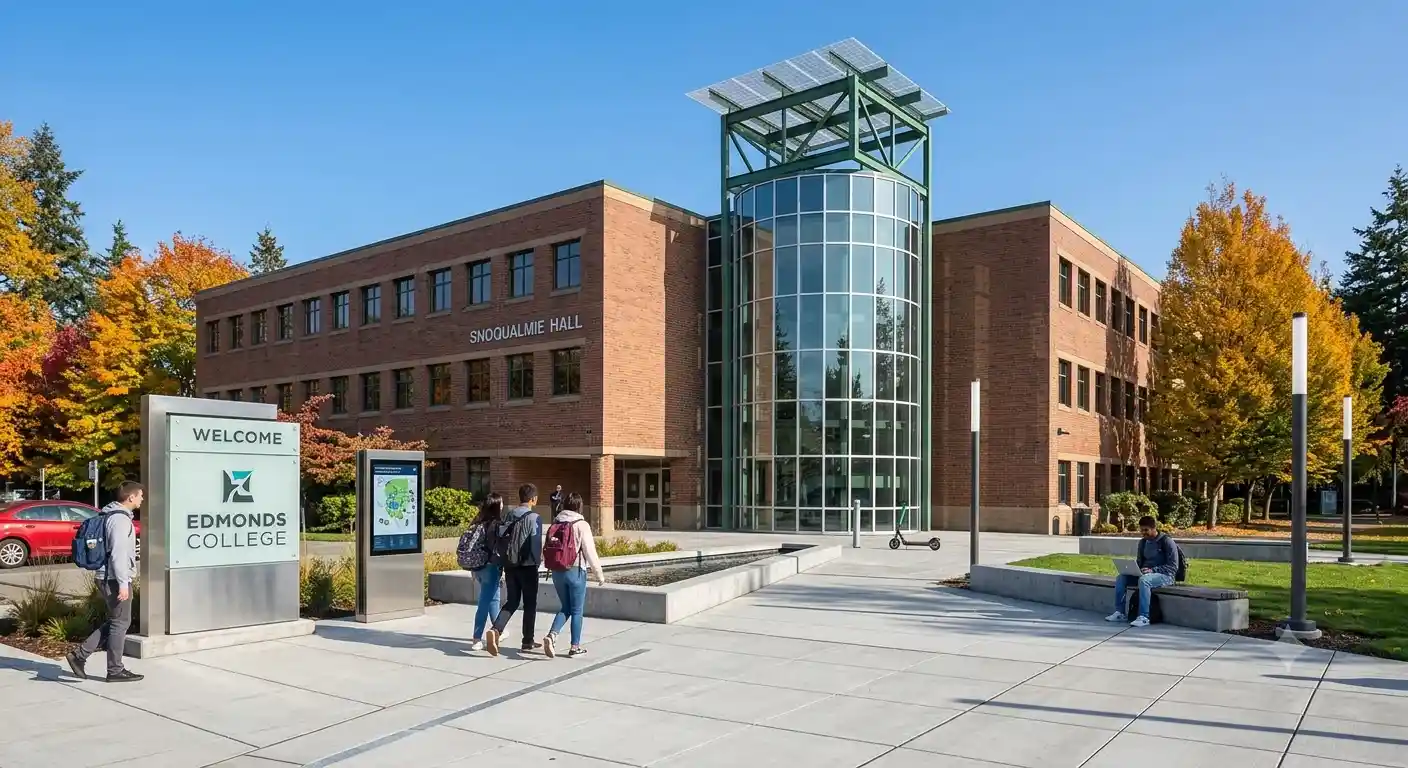
If you ever have the chance to visit campuses like Santa Monica College, De Anza College in Silicon Valley (California), or Bellevue College (Washington), you will be overwhelmed by their massive scale. They are equipped with international-standard biomedical laboratories, industrial robotic engineering workshops, multi-million-dollar performing arts centers, massive globally-connected libraries, and highly secure dormitory systems. The term “village school” is an absolute insult when describing these large-scale, world-class educational academies.
Myth 3: “Studying here means you cannot apply to Top-tier US Universities”
The Truth: Completely contrary to this fear, a US Community College is the legal, safest, and most effective “backdoor” for international students to step into America’s top universities. The education system in this country establishes highly structured transfer agreements known as TAG (Transfer Admission Guarantee) or TAA (Transfer Admission Agreement).
This means that when a student completes their program at a US Community College with the required GPA (usually ranging from 3.0 – 3.5 depending on the major), they are 100% guaranteed admission into the 3rd year of partner universities. You can verify this through the Admissions Portal of the University of California (UC) system (which includes world-renowned names like UC Berkeley, UCLA, UC Davis…). According to their policy, the UC system prioritizes accepting transfer students from community colleges within California over international students applying directly from high school. The rate of successful transfer students getting into UC Berkeley is many times higher than that of an international high schooler competing directly from Vietnam.
Myth 4: “A US Community College degree has no value when job hunting”
The Truth: Parents need to understand the pathway clearly. After completing 2 years of general education, students will receive an Associate Degree (Associate of Arts/Science). This degree is fully recognized across the United States and globally. However, the ultimate goal of the US Community College pathway doesn’t stop there; it aims for a Bachelor’s Degree.
When you study for 2 years at a Community College, then transfer to a 4-year University and study your final 2 years in your major, the Bachelor’s degree you receive at graduation is issued directly by that prestigious 4-year University. On your degree, there is absolutely no line or indication that you ever attended a US Community College. The value of your degree, skills, and knowledge are entirely equivalent and identical to a student who paid expensive tuition to study at that university for all 4 years.
Myth 5: “Poor learning environment, unqualified teachers, and bad peer influences”
The Truth: This is a severe misunderstanding of the teaching structure within the US education system. At large-scale universities (National Universities), top professors are often heavily involved in scientific research and writing books. In general education classes during the 1st and 2nd years, held in massive lecture halls with up to 300 – 500 students, the person actually teaching is often just a Teaching Assistant (TA)—a student currently pursuing their Master’s or Ph.D.
In contrast, at US Community Colleges, the sole and most sacred duty of the faculty is Teaching. Class sizes are strictly controlled, hovering around only 20-30 students per class. The direct instructors are Professors, PhDs, and Masters with full pedagogical certifications and years of practical experience. International students have the opportunity for 1:1 direct interaction with their professors, making it easy to ask questions, discuss, keep up with coursework, and improve their English without the pressure of being “drowned out” in a lecture hall of hundreds. This is considered the perfect “Academic Culture Shock” prevention method for Vietnamese international students when they first arrive in the US.
3. The 2+2 Pathway at US Community Colleges: The Financial “Secret” of the Study Abroad Elite
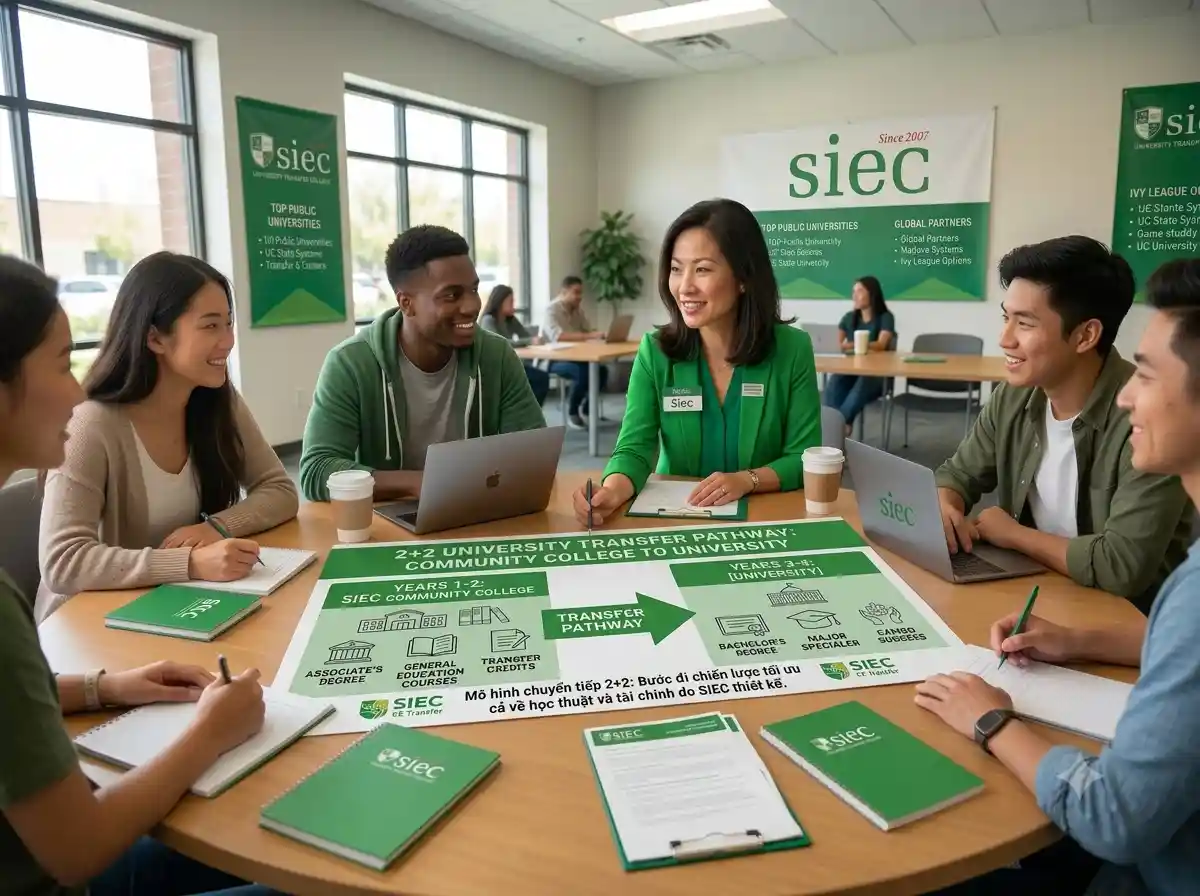
One of the massive driving forces making US Community Colleges an irreversible global trend is the financial optimization equation. The 2+2 pathway (2 years Community College + 2 years University) is the smart financial strategy that SIEC’s education experts always advise parents to consider, especially amidst inflation and rising USD exchange rates.
Let’s do a detailed comparative math equation regarding average annual tuition based on statistics from US News Education:
- US Community College Tuition: Extremely reasonable, ranging from only $8,000 – $12,000/year.
- Public University (State University) Tuition: Averages from $25,000 – $40,000/year for international students (Out-of-state tuition).
- Private University Tuition: Very expensive, from $50,000 – $70,000/year, or even higher.
Let’s calculate: If a student studies straight for 4 years at a public university, pure tuition costs will be around $120,000 – $160,000. However, if the family applies the smart 2+2 pathway (first 2 years at CC + final 2 years at a State University), the total tuition is only about: ($10,000 x 2 years) + ($30,000 x 2 years) = $80,000.
The result is that the family saves at least $40,000 to $80,000 (equivalent to 1 to 2 billion VND) while the student still receives the exact same prestigious Bachelor’s degree. This massive amount of savings can entirely be used to cover living expenses, invest in a Master’s degree, or act as valuable startup capital for their future.
4. Undeniable Privileges for Students at These Institutions
Besides the economic benefits and wide-open transfer doors, choosing to study at a US Community College brings “privileges” that students fighting tooth and nail to get directly into a 4-year university rarely experience:
Flexible Admission Requirements, “Rescuing” Weak Academic Profiles
To successfully apply and receive an offer from a Top 100 US University, Vietnamese students usually have to struggle to maintain a Grade Point Average (GPA) of 8.5 or higher, possess a minimum IELTS certificate of 6.5 – 7.0, grind for sky-high SAT/ACT scores, and prepare a slew of outstanding extracurricular activities along with grueling Personal Statements. This is an immense pressure that exhausts many students.
However, with US Community Colleges, admission requirements are incredibly breathable and humane: A student only needs to be 16 years old (depending on state regulations), have completed 10th grade, 11th grade, or graduated from 12th grade, achieve a GPA of 6.0 or higher, and have an IELTS of 5.0 – 5.5. Even if they have absolutely no IELTS or TOEFL scores, schools always provide supplementary English courses (ESL) before entering the main program. No mandatory SAT, no complex essay requirements—the path to the American Dream through this route becomes wide open, minimizing stress for both parents and students.
The “Dual” Program (High School Completion) – A Priceless Time Machine
A very special and groundbreaking highlight unique to the US Community College system in Washington State is the “Dual” Program (High School Completion). The state’s regulations allow international students to pack their bags and enroll in the US just by finishing 10th grade in Vietnam (reaching 16 years of age).
During their 2 years studying here, students will accumulate credits that are double-counted for both a Washington State High School Diploma and an Associate Degree. As a result, at the age of 18, while their peers in Vietnam are still sweating over the stressful National High School Exam, Dual Program students already hold a US Associate Degree and stride proudly straight into their 3rd year of University. This is a leap forward in time, helping students earn their Bachelor’s degree at age 20, graduate early, save 2 years of living expenses, and enter the workforce much earlier than their competitors.
Doubling Internship Opportunities, Expanding OPT Work Rights
An extremely powerful privilege related to career opportunities: International students on F-1 visas in the US are granted Optional Practical Training (OPT) rights by the government. Typically, if you study straight for 4 years at a University, you only get 1 year of OPT (or 3 years if you are in a STEM field) after obtaining your Bachelor’s degree.
However, the magic of the 2+2 pathway through a US Community College lies in this: Students have the full right to register for 1 year of OPT immediately after graduating from Community College. They can go to work to gain experience and earn legal supplementary income. Afterward, they return to school to transfer to a University, complete their final 2 years to get a Bachelor’s degree, and continue to be granted another round of OPT (1-3 years). Possessing practical work experience right during this college phase will make their CVs exponentially brighter, creating an incredibly solid foundation for applying for a Green Card or working long-term in the US later on.
5. Golden Criteria for Choosing the Right US Community College from SIEC Experts
With a massive network of over 1,000 schools spread across 50 states, boasting completely different quality, scale, and orientations, how can Vietnamese parents choose the safest, most reputable, and most suitable “destination” for their children? Based on over 10 years of practical case-handling experience, SIEC outlines 4 core criteria that cannot be ignored:
- Analyzing Transfer Rate and Partner Network: This is a vital factor. Ask to see the list of Universities that the CC has partnership agreements with. Does the school have automatic transfer agreements (TAG/TAA) with prestigious university systems like UC (California), SUNY (New York), or major public universities in the state? If a school has a high rate of international students successfully transferring to Top 100 universities, that is definitive proof of its academic quality.
- Geographical Location and Cost of Living Equation: A US Community College located in the heart of Silicon Valley (like Foothill – De Anza) will certainly provide fantastic networking opportunities in IT and tech, but rent and living expenses will be exorbitant. Conversely, schools in Texas, Ohio, or the suburbs of Washington might offer much more pleasant living costs while maintaining top-tier training quality and facilities. Choosing a location must align with the family’s financial capacity.
- Quality of International Student Support Services (International Student Office): 16 to 18-year-old students will undoubtedly face cultural and academic shock when they first arrive in the US. Does that school have a dedicated counseling office for international students? Are Academic Advisors professional and dedicated to guiding students in choosing the right courses to ensure their credits are transferable? Choosing the wrong courses at a CC can result in lost tuition and having to retake classes upon entering university. Therefore, the ISO’s support is incredibly important.
- Presence of an Honors Program: For students with excellent academic capabilities nurturing ambitions of aiming for Ivy League schools (Harvard, Yale, Princeton…) or Top 30 National Universities, the chosen US Community College must have an Honors Program system. Students in Honors classes will hone in-depth critical thinking skills, participate in scientific research, and gain a tremendous competitive advantage, beating thousands of other applicants when submitting transfer applications.
6. It’s Time for Vietnamese Parents to Change Their Mindset
The world is changing every day, economies are shifting, and education is not outside that rule of adaptation. Stubbornly holding onto outdated prejudices about the “village school” or “second-rate school” label regarding the US Community College system not only demonstrates a serious misunderstanding of Western educational culture but also directly robs children of their safest, most economical, and smartest educational opportunity.
We need to look at it frankly: A US Community College has never been and will never be a place for failures or the incompetent. On the contrary, it is the sharp strategic choice of practical minds. It is a safe launchpad where students have the time to mature psychologically, hone the native language, and get accustomed to self-study methods without being crushed by massive financial pressure and academic workloads in their first years away from home. A journey of a thousand miles always begins with a single step, and a foundational step at a reputable Community College is the sturdiest stepping stone for Vietnamese students to confidently sail out into the great ocean.
DON’T LET PREJUDICE LIMIT YOUR CHILD’S FUTURE!
Every student is a completely unique individual with different capabilities, personalities, and family backgrounds. A study abroad pathway cannot and should not be a one-size-fits-all approach. The team of international education strategy experts at SIEC is ready to analyze profiles, comprehensively evaluate capabilities, and design the most perfect, safest 2+2 transfer pathway for your child.
GET A FREE 2+2 PATHWAY CONSULTATION TODAY
*SIEC is committed to accompanying your family from the very first steps of file preparation until the student is safely settled and successfully transferred to Top US Universities.*