Study in Canada vs. USA 2026: Which Option is the Best Fit for You?
08/12/2025 Phong Nguyen
“Should I **study in Canada or the USA**?” This is more than just a question—it’s a strategic crossroads that will determine your entire future: your education, career path, and even your potential for permanent residency. Both North American education powerhouses offer incredible opportunities, but choosing the wrong path could prevent you from reaching your full potential. When facing the decision to **compare studying in Canada and the US**, a careful assessment of your long-term goals is essential.
This article goes beyond simple figures. As an expert consultant, SIEC provides the most in-depth **Canada vs USA study comparison**, analyzing everything from costs and admission requirements to post-graduation career opportunities and Permanent Residency pathways. This will provide you with an accurate “compass” to make the choice that is best suited for you.
Canada and the US: Two options, two philosophies. Which path is for you?
1. Cost Showdown: Safety vs. The Potential for a “Breakthrough” (Tuition & Scholarship Analysis)
Cost is always the primary factor when considering a **study in Canada vs USA comparison**. The two nations represent two distinct financial strategies.
Canada: Safe and Predictable Option (Fixed Costs)
Generally, tuition and living expenses in Canada are more “manageable.” The average undergraduate tuition for international students ranges from **$25,000 – $40,000 CAD/year**. Notably, costs for College programs start lower, from just **$15,000 – $20,000 CAD/year**, offering significant savings.
The minimum cost of living required by IRCC has recently increased to **$20,635 CAD/year** (updated 2024), replacing the old $10,000 CAD minimum. The total annual cost typically falls between **$45,000 – $60,000 CAD**. Despite the cost increase, the financial path remains clear and transparent.
USA: High Cost but Potential for a “Breakthrough” (Financial Aid System)
Tuition fees in the US have a vast range: public universities cost between **$30,000 – $50,000 USD/year**, while top private universities can reach **$60,000 – $80,000 USD/year**. However, the core difference in the US is the **Need-based Financial Aid** system.
**Need-Blind:** Top universities (like the Ivy League) review applications without regard to a family’s ability to pay, and commit to covering 100% of the cost your family cannot afford (through financial aid packages/scholarships). This is the pathway to receiving a full-ride **US scholarship 2026**.
**Merit-based Scholarships:** The US also offers many merit-based scholarships, but they are often insufficient to cover the entire cost, unlike Need-based Financial Aid.
If your profile is not strong enough to target top schools with substantial financial aid, the total cost of studying in the US will be **significantly higher** than in Canada.
Cost & Scholarship Comparison Table (Per Year)
Criterion
Canada (CAD)
USA (USD)
Tuition (Average Undergraduate)
$25,000 – $40,000
$35,000 – $65,000+
Minimum Living Cost (Visa Requirement)
$20,635 CAD (Fixed)
$15,000 – $25,000 (Varies by state/city)
Full Scholarship Opportunity
Rare, mostly Merit-based (smaller value).
Very High at top universities (Need-based Financial Aid).
In summary, the **Canada vs USA study comparison** on cost requires a candid assessment of your academic potential and financial capability. Canada offers stability; the US offers a high-risk, high-reward opportunity.
2. Admission Requirements: A Game of Numbers vs. Personal Stories
The admission philosophies of the two countries are fundamentally different. This is a crucial point when conducting a **comparison of studying in Canada and the US**.
Canada: Clear-Cut and Academically Focused (Quantitative Review)
To succeed in the **Canada and US study** application process, understanding the admission philosophy is mandatory. Canada’s admission system is transparent and primarily relies on quantitative metrics. Key requirements include GPA (Grade Point Average) and English proficiency certificates (IELTS/TOEFL). A profile with a GPA > 8.0 and IELTS > 6.5 is often sufficient to apply to many quality universities like the University of Toronto, UBC, and McGill. Canada also offers College programs with more accessible entry requirements, providing a more certain academic path for many students.
New Requirement: Provincial Attestation Letter (PAL)
Since 2024, Canada has implemented the **PAL**, increasing competition at the school admission stage. Receiving a **Provincial Attestation Letter (PAL)** depends on whether your chosen institution is granted a quota (Public DLI institutions are prioritized). This factor doesn’t change the school’s academic requirements, but it adds an administrative hurdle that requires earlier application preparation.
USA: Holistic and Searching for a “Unique Edge” (Holistic Review)
Conversely, when you **compare US and Canada study**, the US’s “Holistic Review” philosophy demands a significant investment in non-academic factors. The US admission system follows the **”Holistic Review”** philosophy. GPA, SAT/ACT, and IELTS/TOEFL are only one part. The decisive factors often include:
**Personal Essay:** Telling a unique personal story, demonstrating personality and the ability to overcome challenges.
**Extracurricular Activities:** Showing passion, depth, and leadership ability (depth over breadth).
**Letters of Recommendation (LOR):** The perspective of teachers/counselors on your character and potential.
They seek individuals with a **”unique edge”** and the potential to contribute to the university community. This makes the US application process complex, time-consuming, and extremely competitive at top-tier schools. This is why the **US community college pathway** has become popular, as it simplifies this initial admission requirement.
👉 **Showdown:** If you are strong in scores and prefer a clear process, **choose Canada**. If you are confident in your personal story, extracurricular activities, and are willing to invest effort into a complex portfolio, **aim for the US**.
3. Post-Graduation Opportunities: Certainty vs. The “Lottery Ticket”
This is the core difference when conducting a **study in Canada vs USA comparison** regarding long-term careers and international student support policies.
Canada: Clear Post-Graduation Work Permit (PGWP) Path
This is Canada’s absolute strength in the **study in Canada vs USA** post-graduation comparison. Canada offers a very welcoming Post-Graduation Work Permit (PGWP) policy. Simply completing an eligible study program of eight months or longer at a designated learning institution (DLI) virtually guarantees you an open work permit.
**PGWP Duration:** Programs of two years or more grant a PGWP for up to **3 years** (the golden period for accumulating permanent residency experience).
**Work during Studies:** Students with a Study Permit are allowed to work **20 hours/week** off-campus during school sessions and full-time during scheduled breaks, with no additional work permit required.
USA: OPT/STEM OPT and the H-1B “Lottery”
The biggest contrast in the **study in Canada vs USA** comparison lies in the risky H-1B path. Although the US has extended OPT for STEM fields, the H-1B “lottery” remains the barrier. International students in the US are granted an **OPT (Optional Practical Training)** work authorization for 12 months after graduation. For **STEM** (Science, Technology, Engineering, Mathematics) fields, students can extend this for an additional 24 months, bringing the total OPT time to **36 months**.
However, to stay and work long-term, you need an employer to sponsor you and must successfully win the **H-1B work visa lottery**. The H-1B lottery success rate in recent years has been very low (around **10-15%** according to USCIS data), making it a highly unpredictable obstacle for anyone seeking a long-term career in the US.
Salaries and Job Market
When comparing **Canada and the US** job markets, the US often offers higher salaries, but this comes with a higher cost of living and more intense competition. Regarding compensation, the US generally outperforms Canada. Tech and financial hubs like Silicon Valley and New York pay significantly higher starting salaries than Toronto or Vancouver.
4. **Study in Canada vs USA** Permanent Residency Pathway (The Ultimate Goal)
If your ultimate goal is to immigrate and become a Permanent Resident (PR), the **study in Canada vs USA comparison** will clearly indicate Canada as the superior choice in terms of feasibility.
Canada’s PR Pathway: Points System and Proactive Planning
Canada has built a clear immigration system designed to attract international students. Key programs include:
**Express Entry (CRS System):** Canadian education experience, work experience (using PGWP), and English proficiency grant very high points (Human Capital), allowing students to proactively plan to receive an Invitation to Apply (ITA) for Permanent Residency.
**PNP (Provincial Nominee Program):** Each province has its own immigration streams designed to retain graduates. Examples include the Atlantic Immigration Program (AIP) or Ontario’s OINP.
These PR programs are why Canada consistently scores higher on the immigration front in the **study in Canada vs USA comparison**. **Advantage:** The path is clear, transparent, and you can predict your likelihood of success.
USA’s PR Pathway: Employer Dependence
The path to getting a Green Card in the US is a long and complex process, primarily relying on transitioning from an H-1B (work visa) to a Green Card (EB-2/EB-3), which requires:
Securing a long-term employer sponsor.
Extended waiting times (which can be up to **10 years or more**, depending on country-specific quotas).
**Advantage:** If successful, you will live and work in the world’s leading economic superpower. **Disadvantage:** High risk of failure due to dependence on the H-1B lottery and employer sponsorship, making the path highly uncertain.
5. Living Environment Comparison: Culture, Safety, and Healthcare
Quality of life is a crucial factor when making the decision on **whether to study in Canada or the US**.
5.1. Safety and Social Policies
Canada (Safe and Inclusive): In terms of social safety, the **study in Canada vs USA comparison** shows Canada consistently ranks as one of the safest countries globally. The official **Multiculturalism** policy helps international students integrate easily and feel welcome. Rates of violence and crime are significantly lower than in the US.
USA (Dynamic and Competitive): The US is a highly dynamic nation and a global innovation center. However, crime rates are higher in many major cities. American culture leans towards **Individualism** and competition, requiring international students to be highly proactive and adaptable.
5.2. Healthcare System
Canada: Canada has a **Universal Healthcare** system. Most provinces offer public health insurance to long-term international students (though there is often a waiting period). The cost of basic medical care is largely covered by the government, reducing a major financial burden.
USA: The US healthcare system is **Private/Market-driven**. Medical costs are extremely high. International students are mandated to purchase private health insurance, but even with insurance, co-pays and deductibles can still be very high.
6. Summary: Strengths & Weaknesses of Canada vs. USA
Use this summary table for an overview of the **study in Canada vs USA comparison** based on key factors:
Criterion
Canada (Maple Leaf) 🇨🇦
USA (Statue of Liberty) 🇺🇸
Permanent Residency Goal
Very Easy: Clear PGWP -> Express Entry pathway.
Very Difficult: Depends on H-1B lottery (high risk).
Study Cost
Lower, easy to predict.
Very high, but potential for huge scholarships.
Admission Requirements
Primarily based on GPA and IELTS (Quantitative).
Holistic Review, requires a complex portfolio.
Part-time Work during Study
Off-campus work **20h/week** (straightforward).
Primarily restricted to on-campus work.
Social Environment
Safe, multicultural, and inclusive.
Competitive, dynamic, global economic center.
The Verdict: Should You Study in Canada or the USA?
There is no single best answer, only the answer that is the best fit for YOU. Evaluate yourself based on these criteria after completing the **study in Canada vs USA comparison**.
Choose CANADA if you:
Prioritize a safe, predictable financial plan.
Have a good academic record and want a transparent, less complex application process.
Place long-term career and permanent residency goals above all else.
Prefer a safer, multicultural, and less hectic living environment.
Want to easily work off-campus to cover expenses.
Choose the USA if you:
Have an exceptionally strong academic and extracurricular profile, aiming for top-tier universities and full scholarships.
Are confident in your personal story and ready to invest in a complex application portfolio.
Want access to the most dynamic and competitive job market globally (despite the high risk).
Love the diversity, pace, and innovation of American culture.
Prioritize higher starting salaries (even with higher living costs).
Don’t Decide Alone
The **study in Canada vs USA** decision is complex, requiring a deep analysis of your own ability, finances, and long-term goals. Don’t let overwhelming information confuse you. With experience advising thousands of students who have succeeded in both countries, SIEC will help you analyze every strength and weakness and build a personalized, custom-fit roadmap.
SIEC’s expert team will provide you with detailed support on:
Strategy for applying for the **Canada PAL** and documentation for the new **$20,635 CAD** proof of funds.
Building a perfect **Holistic Review** portfolio to compete for US scholarships.
Advising on the most suitable **PGWP/Express Entry (Canada)** or **OPT/H-1B (USA)** pathway based on your major.
**Contact SIEC today** for a free 1-on-1 consultation and make the most informed choice after a comprehensive **study in Canada vs USA comparison**!
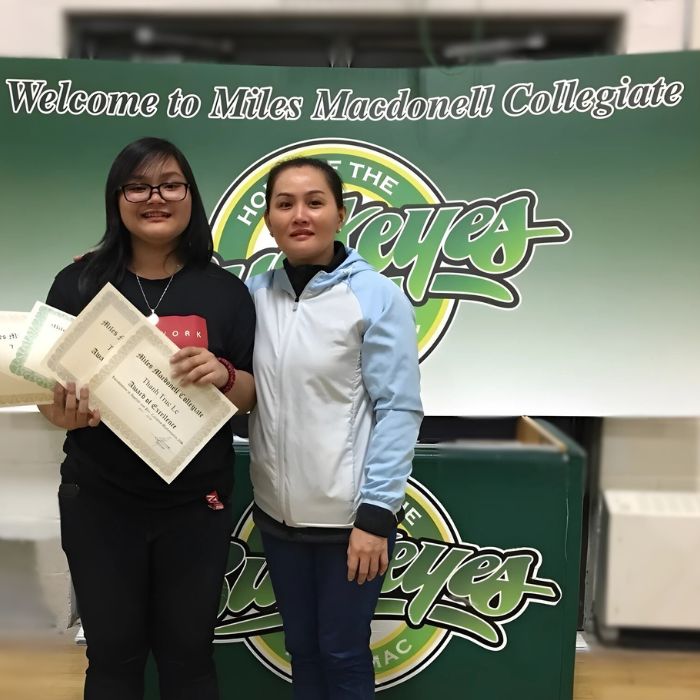
Lê Thanh Trúc, Student at Miles Macdonell Collegiate
“My family and I are deeply grateful to SIEC for not only securing my **Canada high school student visa** in Grade 10 but also for assisting my parents and siblings in obtaining their **visitor visas**. That was an invaluable gift.” — Lê Thanh Trúc, Student at **Miles Macdonell Collegiate** Secure Your Early High School (Secondary) […]
Phan Thị Ngọc Huỳnh, Former Student in Winnipeg
“The solid foundation provided by SIEC and Ms. Huong not only helped me realize my study abroad dream but also gave me the confidence to graduate, secure a stable job, and **settle permanently in Canada**.” — Phan Thị Ngọc Huỳnh, Former Student, currently working in **Winnipeg, Canada** Explore Your Study & Immigration Pathway in Canada […]
Hoàng Giang, Student at Edmonds College
“With her dedication and passion, Ms. Huong helped launch my **American dream**, opening up a vast world of opportunity and the chance to meet new friends.” — Hoàng Giang, Student at **Edmonds College** Explore More About Studying in the USA Spotlight on Edmonds College (Washington State) Gain in-depth knowledge about the programs, tuition fees, and […]
Khánh Lê, Student at LaSalle College
“Thank you to Ms. Huong and the SIEC team for their dedicated partnership and support, from my application phase until I was settled in Canada, helping me confidently pursue my dreams.” — Khánh Lê, Student at **LaSalle College** Explore Further Canada Study Opportunities Spotlight on LaSalle College Gain deeper insights into the programs, tuition fees, […]
Quỳnh Giao, Student at Red River Colleg
“She didn’t just stop at completing the application; she was an inspiration, a true motivator…” — Quỳnh Giao, Student at **Red River College** Continue Your Canada Study Abroad Journey Spotlight on Red River College Polytechnic (RRC Polytech) Discover the high-demand, **applied learning programs** at **Red River College** – one of the premier post-secondary institutions in […]